October 11, 2021

Fascinating & Apotropaic

 Weird Squash, Odd Jewelry

By Amy Barr with The Lukeion Project
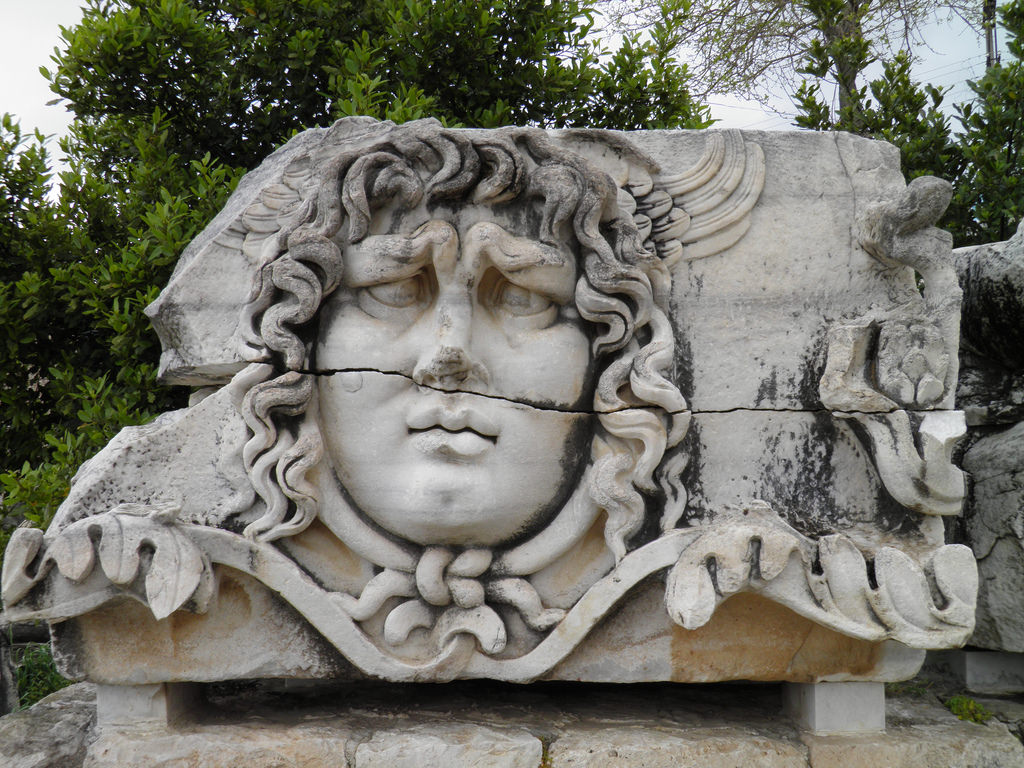
Apotropaic comes from Greek αποτρέπειν "to ward off." It comes from από- "away" and τρέπειν "to turn,” specifically “to ward off evil.” Every world culture has a superstitious quirk or two that people employ in an effort to ward off evil (or maybe even bring good luck). True to human nature, we might think our grandmother’s admonition to avoid walking under ladders or opening umbrellas in the house sounds as normal as decorating the barn with a lucky horseshoe. We are less likely to accept superstitious quirks from other cultures as normal, so I have collected a few here to entertain us all.

If one wanted to ward off evil in ancient Greece, one would decorate clothes, buildings, or jewelry with the face of a gorgon to stop evil in its tracks just like Medusa could drop you dead like a rock with just one glance. The gorgon’s face was not pleasant. It had fangs, wild eyes, a protruding tongue, and unruly hair. Now that I think about it, this also describes me before I have had some coffee in the morning.
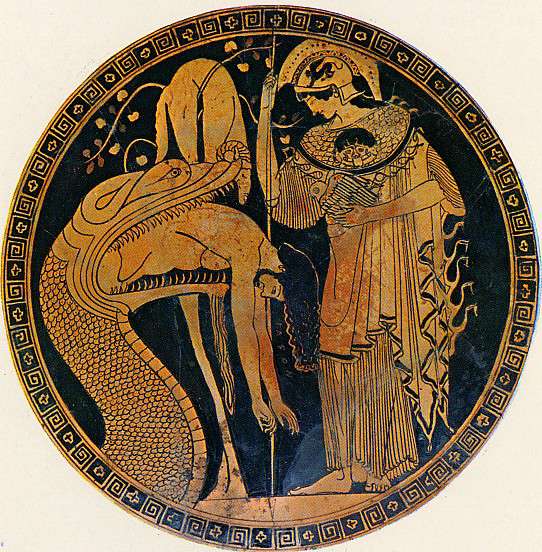
A gorgon’s face was a standard ornament for armor but also used in architecture, clothing, rugs, and jewelry. According to standard mythology, the Greek goddess Athena put on her dad’s favorite jacket, the Aegis, and then decorated it with a gorgon’s face as a fitting example to humans about the proper way to turn away evil while dressing well.

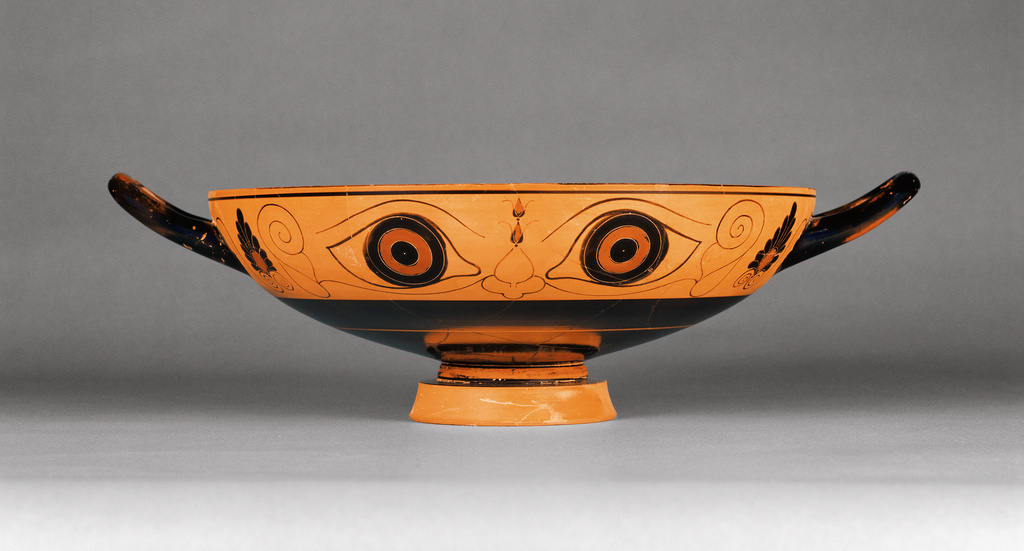
Likely related to the scary gorgon’s face was the representation of eyes, either as a set or singleton, to intimidate evil. Drawing a single eye was much easier than illustrating a gorgon. For the art impaired, drawing an eye was a cheap, fast, easy means to ward off malevolent glares. In ancient Greece there were eyes on cups (lest one swallow evil) and ships (shipwrecks were a big problem). If you visit modern Greece or much of the eastern Mediterranean, you will see a similar symbol adorning everything from buses and homes to fine jewelry. The iconic Mati or blue eye often appears in a lovely Aegean blue glass (much nicer than the fanged googly-eyed original). These make a lovely way to give evil the boot.
The Romans chased off evil or envious glances with jokes and funny pictures. Both the Greeks and Romans used images or charms of (ehem) a certain body part to scare away evil. These charms – often used for earrings, lamps, or necklaces—were called fascinum/fascina. The term “fascinating” comes from the name of these (ehem) charms. The term was meant to imply that one had been put under a spell. The term may or may not have anything to do with the fasces, the bundle of rods and an ax carried by lictors before the Roman consul. Fasces, not fascina, led to the modern term “fascism.”

Meanwhile, back to scary faces: gargoyles were ugly enough to scare evil away from important buildings in Europe. The English term “hunky punk” described grotesque scary carved architectural bits, but I think it might fit for some members of boy bands.
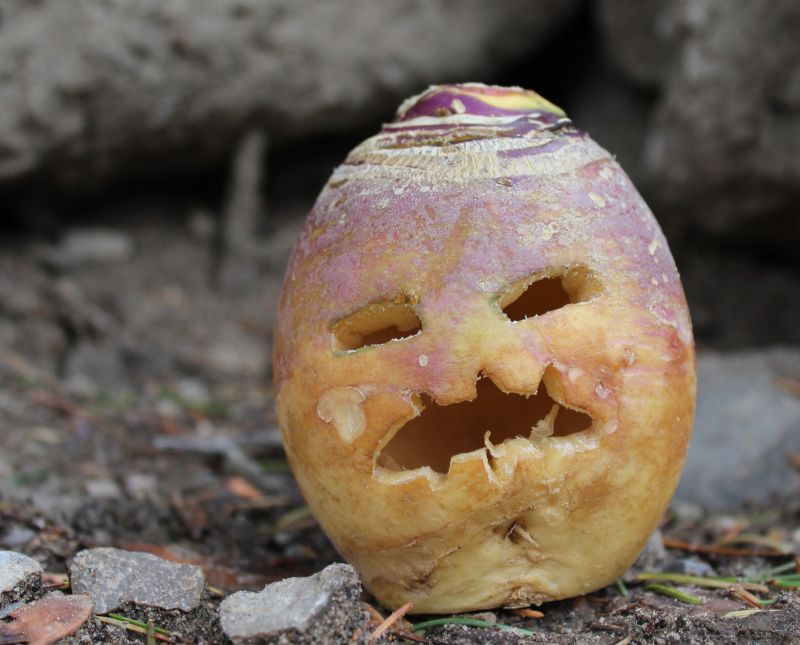

If one wanted an affordable home-spun ugly carved-thing, turnips did the trick for many years. Thankfully, turnips are as difficult to carve as they are to eat so other fruits or vegetables cycled through the list of options. Celts adopted winter cucurbits (squash, melons, etc) as an easier way to scare away evil since they were available right after harvest when people celebrated the new year.

The idea of apotropaic fall fruits resonated well in the early colonies of the United States where settlers needed some extra good luck. North American tribes gave us the names for squash (a Massachusett word, askꝏtasquash or a Narragansett word, askútasquash) and pumpkin (Massachusett pôhpukun meaning “grows forth round”). 

Growers are happy to offer every type of pumpkin, squash, and gourd for the purpose carving and stacking while (thankfully) turnips fell out of style. These carve-worthy fruits make tasty pies for Thanksgiving plus delicious roasted the seeds!


 

September 27, 2021

Failure is a Valuable Learning Tool

Toddle –To walk with short, unsteady steps

By Amy Barr with The Lukeion Project 

    All three of my clever competent children have successfully made it to adulthood in one piece. When they were toddlers, I was not so sure they would cross that finish line. When children learn to walk and then go careening into their new world to explore, their development is nothing short of death-defying. There will be endless head-bonks. Gravity will be challenged. Cats, houseplants, fragile items, and parental patience will be fully tested. Learning to toddle out into the world requires trial and error. Success is almost certain unless a toddler is kept too safe. Trial and error are necessary.

Fast forward to a person’s school years when new challenges line up. Failures are not measured by toppled chairs or head bonks (at least not too often), but challenges remain necessary for those who want success.

Children who will learn to cook must be able to chop food (with a knife!) and use a stove. Those who take up a new instrument will experience plenty of sour notes. Everyone who wants to learn dance or to excel in gymnastics, will endure more than a few sore ankles and stubbed toes. Want to learn to ride a bike, use roller skates, master a skateboard, or play football? Get ready for bonks, bruises, and broken bits. It is normal. It is required! Nobody expects to be the top gymnast, execute a 180 heelflip, or score a winning touchdown before loads of challenging work and a stack of failures.

We humans expect consistent setbacks when learning new physical skills, but do not offer ourselves the same grace when mastering new academic skills.

As we progress through our education, we decide about our skillsets too quickly. We learn to self-identify as math or science kids, “bookworms,” “creatives,” or “jocks” even though we must all master math, physical activities, literature, writing or expression. We must all get in touch with our own creativity plus a bit of biology and botany.

Few of us become a polymath, one whose knowledge spans a substantial number of subjects and draw on complex bodies of knowledge. Why? We interpret academic bonks and bruises differently; we think they are proof that we will never be good at something academic.

“Ugh! I get mediocre grades in algebra, I’m just not a math person.”

“Yuck, I never do well on written projects. These are too difficult.”

“My creative project wasn’t half as good as everyone else’s. I guess I’m not creative.”

What if we let our academic bonks and bruises serve us the same way they do when learning physical skills? Do you regularly miss deadlines? Let that bonk teach you new ways to manage time. Do you often miss details on tested subjects? Produce new mastery technics that suit your brain best. Do you lose interest and focus during reading assignments? That bruise is not there to get you to stop reading but tell you it is time to find coping mechanisms that help you retain focus throughout a whole assignment.

Finally, do not fall for the poor advice that you are perfect just the way you are, no more effort needed. You and I both know that you would prefer to feel confident about things that interest you and you would rather feel at least competent in things that interest you less. Humans are happiest when we are toddling forward, learning new things, and acquiring new skills. Bruises and bonks let us know when to strengthen ourselves in some way so we can become proficient, then competent, and then finally confident. Failure is a valuable learning tool.

September 13, 2021

Melancholy is a Classical Mood

Gear up for New Beginnings

Amy Barr of The Lukeion Project

The world is currently suffering from some very Classical maladies such as melancholy, a term that comes from Greek: µέλαινα χολή melaina chole meaning “black bile.” In the 5th and 4th centuries BC. Hippocrates, in his work Aphorisms (from Greek ἀφορισμός: aphorismos, meaning concise or memorable expressions of a general truth), characterized the condition of having long-lasting fears and despondence as melancholia, a physical problem characterized by mental symptoms.

If you prefer some Latin roots, try lugubriousness (Latin lugere, "to mourn") or moroseness, (Latin morosus, "self-will or fastidious habit"); and saturnineness, (Sāturnīnus, "under the influence of the planet Saturn") which brings us back full circle since both Greeks and Romans thought dark moods meant one was under the influence of the planet Saturn.

Both the Greeks and Romans viewed the god Saturn (Cronos to the Greeks) as being the guy in charge of agriculture (specifically the harvest), periodic renewal, and liberation. He’s the one we see as an old man carrying a sickle due to his primary job in agriculture. His iconography is often confused with the “grim reaper” in modern times. Even a few decades ago, Saturn was the illustration commonly used along side best wishes as we would ring in a happy new year. His overall vibe was “out with the old, in with the new.” The Romans named January after the two-faced god Janus, a fellow that was in charge of endings and, simultaneous new beginnings.

Melancholy, a mournful wistfulness, often precedes great changes. The “best of all holidays,” according to the Roman poet Catullus, was the festival for Saturn in late December. About the time they couldn't stand one more long dark dreary cold day, the Romans threw huge parties, decorated everything lavishly, exchanged jobs between the powerless and powerful while they also exchanged gifts to celebrate Saturnalia.

As an educator, I have seen a lot of students suffering from melancholy over the past 18 months. Who can blame them? It can be difficult to focus on mundane classwork if one isn’t certain what life will look like in an uncertain future. Everyone is wistful about the past and uneasy in their new terrain. Uncharted territory isn’t all that fun.

Students: even if gloom is in the room and typical enticements are few, what can offer sufficient inspiration to engage in one’s studies with excellence even during times of great uncertainty?

Prior to roughly 100 years ago, no significant percentage of the population enjoyed a college education. People were not, contrary to modern spin, poorly educated. On the contrary! Flip through an original edition of McGuffey Readers to see that most students mastered material by 6th grade that colleges won’t touch until students enter upper-level seminars, if ever. While the decline (collapse) of education is worthy of multiple blogs, suffice it to say that history’s best thinkers, inventors, writers, speakers, artists, musicians, and entrepreneurs achieved greatness without pomp and circumstance.

A good education—one that is rich with literature and well-stocked with essentials like language mastery, logic, rhetoric, sciences, maths, and then adorned with music, arts, and a broad exposure to practical skills—is the key to unlocking the future in any form it might take.

The future should not be framed in terms of diplomas and acceptance letters even under the best conditions. In times of great uncertainty and certain change, think of education as an epic RPG (roll playing game, for you old folks) in which YOU prepare yourself for the ultimate boss by accumulating skills and strengths in your path. There’s no older sibling or neighbor to spoil the end of this game for you and there are few cheat codes available. You will have no idea what the final boss will throw at you so get ready now. Accumulate strengths, skills, experience, energy, equipment, and even teammates to help you along the way. Train well and you’ll succeed, even if all your battles will be fought in new territory.

Curiosity Beats Confidence

By Amy Barr with The Lukeion Project Is it true that there’s no such thing as a dumb question? Of course there are dumb questions. As a te...