Showing posts with label teaching. Show all posts

November 6, 2023

Autodidacticism

You Have Everything YOU Need For a Good Education

Amy Barr with The Lukeion Project

The English word “education” comes from the Latin word educare, a verb that can refer to the process of bringing up children to adulthood or providing a wholesome place for animals or crops to grow. Modern usage would have us think that education is a commodity that we might purchase in the form of a book, a program, a class, or whole degree program. When we are done with one or all of these, we proclaim ourselves “educated.” The Latin word does not refer to any of these things, per se. Instead, one’s education is a matter of having a favorable environment or fertile soil for somebody (or something) to grow productively. Education, for much of human history, has been a personal choice and under our own control.

In the Roman world, those that worked on a subject very diligently might eventually be considered doctus by others, meaning they were well-informed, experienced, and clever. Doctus is a passive participle of doceo, a verb which means “teach” (a doctor was a teacher not a medical expert). Somebody who is doctus has been “taught” but not necessarily by others and certainly not in some established program. Remove your modern sensibilities about being taught. The English words we use to define doctus or docta have more to do with how one treats oneself as one builds one’s own learning environment. A well-informed, experienced, and clever person takes the initiative to self-educate regardless of one’s station in life.

The most brilliant men and women in history have been autodidacts who, until very recently, had zero framed diplomas hanging in their offices. Degrees, as such, didn’t factor into anyone’s career qualifications until the far more recent past. The notion of placing a measure (and certificate of completion) on one’s education was not something that most people thought about until public education compelled us to think in terms of something that could be measured, quantified, qualified, and marketed to the human race.

Greek philosopher Plato once said, “The first and best victory is to conquer self.” Aristotle, Plato’s student, listened carefully to his master’s words for 20 years and then reversed his opinion on most of Plato’s teachings to form his own thoughts. He famously said, “Through self-discipline comes freedom.” As he too would become an educator of famous people like Alexander the Great, Aristotle would also say “What lies in our power to do, lies in our power not to do.”

Education today is not something our Classical fore-bearers would recognize or condone. Today we view education as a set of stairs. We climb up some of those steps and celebrate when we’ve arrived at a certain stage while we earn a slip of paper that some institution has issued to say as much. Leaving behind all that was accomplished before, we climb a new set of slightly more difficult stairs and look for new affirmations of completion until, armed with seemingly enough certificates, we are deemed qualified. Those that didn’t climb those particular stairs are not authorized to form opinions or advice in that area. Such people are merely amateurs, a word that comes from the word for love (amare) in Latin. 

Modern education is a lucrative system that is jealous of all forms of competition. We are told we aren’t qualified to do our own research and we aren’t qualified to educate ourselves. Those who are home-educated must simulate a public education by jumping through similar hoops in hopes of being issued a graduation certificate which, despite numerous studies that prove that home education is the far superior method of learning, is often considered sub-standard by many secondary institutions. Many top universities are slowly understanding how valuable our home educated autodidacts are! The top skill mastered in home education is how to educate oneself, a skill that becomes a game-changing advantage in college, graduate school, career, and life. Those that don't want any part of that type of conveyor belt system are benefited as they teach themselves how to live the kind of life that interests them most. 

Autodidacticism (self-education) is and has always been the most reliable method to become well-informed, experienced, and clever. Our own interests and passions are a powerful tool to compel us to excel. Autodidacts are never sated with mastering a single body of knowledge. Having learned one and then two, self-educators are driven to learn by their own interests. They choose to master more and still more. While such people often go on to collect a variety of degrees because they are still constrained by our modern system, they will always continue their own learning process provided they have life and breath.

As Plato points out, your first task is to master as an autodidact is self-discipline. Rising above your own lazy instincts to sleep more or play more means you’ll have the ability to push on, to persist in your efforts to master some topic or skill. If you have enough self-discipline to persist, there are no limits to your goals or ambitions. This is true freedom. The choice falls on you. You have control over your own timeline, effort, and skill. Degree programs might require a set number of years and certainly a prearranged fee, but a self-disciplined autodidact has control of his own time, her own effort, and the quality of all outcomes. Armed with far more educational materials and opportunities than history’s brightest minds, the best education today can be free, or nearly so.




November 15, 2021

Docere et Discere

Learning How to Teach vs. Teaching How to Learn

By Amy Barr of The Lukeion Project

As the world has changed rapidly, so too has education. Some parents who might have rarely pondered pedagogy were forced to discover new ways to balance out the chaos of their child’s on-again-off-again education. Home education has more than doubled in the last year as more are taking matters into their own hands. The Lukeion Project has welcomed many new families seeking to either supplement their children’s education or, having newly switched to home education full time, provide some much needed educational help. I figured some teaching insights from the ancient world might bring perspective. The Romans had a lot of thoughts about learning, teaching, and being teachable.

The Latin verb docere (to teach, to point out) is the source of the English word “doctor,” a person who is an educator (not a medical professional who was a medicor). Also a doctor was a person who has already been taught or well-instructed, coming from the verb’s passive participle doctus. The Romans would have also used this participial form to describe an experienced or clever person who knew a subject very thoroughly which really the source of one earning one’s “doctorate” degree. Docte is a related adverb meaning “shrewdly” or “cleverly.”

Monere (also meaning “to warn” or “to remind” about something that a person should already know). A monitor (from which we get the modern English word) meant “prompter” as in a person who sits discreetly near a stage to help actors remember forgotten lines. By-and-by the English word “monetary” comes from the same verb but that’s a very convoluted story to include here.

Instruere (where we get “instruction” and “instructor”) meant “to build or prepare.” This verb (struo or instruo) might be used setting up one’s home, setting up a battle line, or building a wall. The passive participle instructus means a combination of “equipped” and “supplied.”

Praecipere means to “to warn” and also “to anticipate.” When using the word to indicate “to teach,” the writer implies how an educator equips the learner to be ready for something that will eventually happen. A praeceptum (precept) is a command or rule—something that must and will happen so one must plan for it.

We get the English word erudite (scholarly) from erudire which can mean “to instruct” in the sense of taming or removing roughness from a student. Look at ex + rudis, a word meaning rough, raw, or uncultivated sort of like a weedy field before it is made into a garden.  

Bringing young people along in their education has always been a mix of forming, warning, building, furnishing, and equipping—but what about the job of being educated? What is a student’s responsibility in all this?  

The Latin verb reperire means “to learn” in the sense of finding out, obtaining, getting to know something. A repertor was a discoverer or inventor. Both words come from re + parere, a word meaning “to produce” or “to create.”Reperire also means “to create again and again.”

Discere, from which we get “discovery” a term related to “didactic,” means “to acquire knowledge of” or “to find out” in much the same way that an investigator discovers the facts of a situation. The -sc- part of the word is a special ingredient in Latin that suggests the process takes time and grows as it goes (we call -sc- an inceptive).  Similarly, the verb conperire also means “to discover by investigation.” From this Latin verb we get the English word “compare,” like when we hold up several objects and investigate the differences.

 The verb percipere means “to collect” or “to seize” as well as “to learn.” A perceptive person mentally comprehends all the principles at hand and collects them in mind much like a detective.

Notice how all the words for educating suggest a supporting role (like a tour guide or the person that helps remind a student of forgotten lines or maybe the person that keeps the supplies available). The words for learning are active and primary. The student is the investigator, builder, observer, the main agent in gleaning and gaining knowledge. The educator? Our job is just to be here to help.

November 16, 2020

Make or Break College Preparedness Skills: Subject Mastery

By Amy Barr, Sage Thinkiac at The Lukeion Project

Subject mastery isn’t usually something people think about during middle and high school years. At least for many, a modern high school education is nothing more than a mad dash to complete a list of class hours served before we hurry off to complete the next list of hours to serve. Does everyone need the same semester of time to learn algebra or biology or French? There’s nothing magical about a semester on one subject, or a week of classes, or an hour of lecture. Some students can master the material in a fraction of the time, others need triple with a dollop of review mixed in daily. If a certain subject is poorly presented—for any variety of reasons—all the time in the world won’t help bored students. 

Instead of the time-served approach (exactly like a prison sentence ) what if we return to a subject mastery approach. To do so, students need a few basic learn-how-to-learn skills that have fallen out of favor. Memorization, for example, has been tossed out in favor of “subject tools.” Mainstream educators argue that students simply need to know how and where to access the information they need to complete their work. In the modern world, they argue, it isn’t necessary to memorize the periodic table, the anatomy of a cell, or Latin verb forms when one can just look online. Imagine giving a baby a dictionary rather than expecting him to form new words for himself. Requiring a child to swim laps before she can kick-and-paddle is a cruel recipe for disaster. Telling a student to rely on “subject tools” year after year is equally cruel. 

But, one might argue, if a child isn’t going to become a biologist, Latin teacher, or physicist, does she really need a storehouse of memorized data to make progress in science, language, and math? Children will never one day become any of these things without memorization, and we wouldn’t want them to. Consider the difference between a memorized speech and one read from a teleprompter. An actor reading lines from cue cards can’t compare with one who memorized his lines. Your heart surgeon shouldn’t be searching subject tools while you are under her knife. A concert pianist never performs with sheet music. Your physical therapist should already know how to improve your poor swollen knee without a fast web search. 

Memorization is essential, normal, and not all that difficult once you get the hang of it. There are dozens of techniques for subject mastery that will help anyone do it well at any age. Here are just five methods that will work for anyone mastering anything.      

Write it out 

Qui scribit bis legit, “He who writes learns twice.”

The act of writing helps us remember. You can master a lot of information very quickly just by writing it out a couple of times. Take notes while listening or reading to cut study time down considerably. A student activates all mental muscles when pen is put to paper. Sight, sound, higher reasoning, analysis, and coordination all work together to help the student remember the material. Transcription is still an excellent way to teach spelling to younger students for this reason. Some teens lament they hate taking notes, but I know firsthand how information retention improves just by helping them build this skill.  

When it comes to note-taking, the magic only happens when pen or pencil hits paper. I don’t care if your handwriting is messy. Taking notes is the real secret. No one cares how they look.

Involve all your senses

"All our knowledge begins with the senses, proceeds then to the understanding, and ends with reason. There is nothing higher than reason." –Immanuel Kant

Good note taking habits make mastery easy because multiple senses are put to work. All effective study techniques involve more than one sense. When I ask a young student to “study” for an exam, he’ll likely flip open his book and stare at the words, hoping they will soak in. This is an exercise in futility. Teach  your young ones how to study actively. Tell them to try a variety of approaches including reading it aloud, writing it, drawing it, dancing it, singing it. Flash cards are still a powerful tool simply because they involve more than once sense. If done well, flash cards are portable, cheap, and used by subject masters worldwide. 

Teach it 

Homines, dum docent, discunt, “People learn while they teach.” (Seneca)

When I was in graduate school two of my fellow students had been teaching high school Latin for years. Though they were proficient in Latin when they started their teaching career, they had become excellent at it while teaching it at the high school level. The rest of us trailed behind by comparison. This principal applies to every subject and is one of the best perks of home education, especially at the high school level. We adults get to relearn all sorts of forgotten tidbits as we teach them to our children. When a big sibling instructs a little brother one of his favorite subjects, he has the chance to become exceptional at that subject. The practice of carefully explaining and illustrating anything makes one more proficient at it which is why assigning presentations is a good idea. Parent educators with large families shouldn’t feel bad about employing older siblings to educate younger ones within reason. They will gain as much as they give. If you have an only child, just ask her to teach the material to you or a friend.

Mix it up

"It may be that when we no longer know what to do we have come to our real work, and that when we no longer know which way to go we have come to our real journey. The mind that is not baffled is not employed. The impeded stream is the one that sings." –Wendell Berry

Even the best study method can grow stale if used in isolation. Try a variety of study techniques so that mastery will come quickly and painlessly. Everyone has a slightly different learning style. Chanting something might work well for one person but utterly fail for others. Try out games, flash cards, study partners, diagrams, silly rhymes, funny songs, chalk drawings on the sidewalk, play acting on videos, and even audio recordings: Be creative. 

Do a little every day 

Assiduus usus uni rei deditus et ingenium et artem saepe vincit, “Constant practice devoted to one subject often outdoes both intelligence and skill.” (Cicero)

The battle for mastery over a subject is not won in a single night. How many of us can recount times when we pulled all-nighters in college? If only I could get back all that sleep I lost on geology and Hittites, about which (I should point out) I recall very little. To every cram-session success story you’ll hear a dozen sad tales of poorly written essays, flagging health, and plummeting grades. Help your student learn how to study a little every day. 30 or 40 minutes of clearheaded memorization over a week’s time is far better than 4 fog-brained hours the night before the quiz. Sleep is as essential to organizing and storing data as are short effective study sessions. Alternating periods of both are key.

Students will argue they are preparing for an exam while their brains fight for concentration between notifications from social media, the urge to change songs on a playlist, and a hilarious video complete with ads. They think this works because they haven’t ever tried it any other way. Study sessions should be conducted in a distraction-free zone. Phones, internet, television, social media, friends, and siblings will always win the competition for brain time. Even little distractions like music will conspire to rob a student of subject mastery. 20 minutes with no distractions will be far more effective than 2 hours with them. Short effective study sessions with small rewards for success and a nice break in-between sessions.

So, even if you are educated now (as most are) under the time-served style, you can turn time into mastery with just these few special skills that will give your brain super-powers. 


September 7, 2020

Above All, Don’t Quash the Squash

Sundry Garden Metaphors for Educating your Own

By Amy E. Barr, Latin guru at The Lukeion Project

Pardon all the garden talk lately. It is that time of year. I moved to the middle of nowhere so I could have a big garden, chickens, fruit trees, and fewer neighbors. Before I took up the responsibilities of owning a bit of land, I fancied myself as clever about growing things. I was wrong. My horticultural efforts are only impressive to the most amateur neophytes and those that see my carefully edited photographs on Insta. Painful comparison of my efforts to successful growers comes weekly when I visit the nearby Amish community. Their lovely produce is a nice supplement to my inability to grow enough potatoes and cucumbers in any given year. I confess I did manage to produce some fine cabbages and squash this year for once. I’ve been growing things and gardening since I was a kid, but I still have a lot to learn.

If I were to give up my day job teaching Latin, it would be fun to teach gardening lessons. My first bits of advice would be: prune often, coddle seldom, and thin regularly. Since my day job is teaching young people, my advice can be a bit similar so hang in there, we are about to talk veggies.

Prune Often

Tomatoes, roses, peach trees, and most people, do best with regular pruning. When it comes to people, think of pruning in terms of well-calculated challenges. Twelve long years of bland or overly simplified education results in adults who seldom bloom. If a tomato just sprawls on the ground, it will continue to leaf, but it will not produce much fruit. Challenging a plant with a good pruning along with a bit of support and feeding, followed by several more pruning sessions is a good tactic in education. Support and nourish? Yes. Challenge and rectify? Also, a big yes. Growth, blooms, and fruit are stimulated when students encounter challenging subjects, endure a set back or two, and then learn to grow past failures and challenges while they meet new ones.

I once met a gifted student who was terrified by the thought of even the smallest academic failure. His terror was so severe that he had to be cajoled into completing every single assignment given to him. Hoping to mitigate his academic anxiety, his mother made it far worse by constantly trying to “help” him avoid those very academic challenges. She begged for extensions, she pled for special grading, she demanded a unique schedule, even though this student performed quite well whenever he decided to do so. This student had been fed and supported, but never pruned much.      

Coddle Seldom

This year I grew a bed of giant sunflowers. I love their cheerful yellow but admire their ambitions to grow to 10 or 12 feet before sustaining the weight of massive seed-filled blooms. Winds, thunderstorms, squirrels, and a few chomps from our old goat Otis (living next door) did not knock them down. They went from sprouts to towering giants in a few months. They grew strong because they were not shielded from sun, wind, and rain. They were given appropriate challenges along maturation so that I never had to prop them up artificially.

Students can grow the same way. Education shouldn’t be something done TO or FOR a child, with minimal expectations of the child’s engagement in his or her own education…yet it often is.  There’s no magic grade level in which a student can start working on challenging or exciting subjects after clocking enough hours in boring worksheets, primers, and prerequisites…yet we often think there is.  Likewise, too powerful a challenge at too young an age can stunt grown.

Learners are like young plants. The wind must blow, and the rain must fall from the start so that a student responds appropriately and grows strong enough to sustain harder challenges. Greenhouse veggies are tender, but they need hardening-off before you can plop them in the garden. Don’t keep your learner in the greenhouse for twelve years. Let them enjoy some sun and rain now.    

I once spoke with a person who bought an exotic specimen tree for her front yard. Since the tree was still small but represented a sizable investment for her landscape, she strapped a strong pole to the little trunk to make sure it grew straight and tall. After the tree had grown for two years, she decided it was mature enough to remove the support pole. She was horrified to find her little tree snapped in half after a rainstorm a week later. Strapped to external support, the coddled tree had not encountered any real challenges as it grew. It appeared to have been maturing, but appearances were deceptive.

Thin Regularly

Carrots are difficult vegetables. They don’t like to germinate and, when they do, they take their sweet time about it. Carrot experts always plant way more seeds than necessary if they plan to get a normal harvest. If one is patient enough to grow carrots, one is also aware of the need to thin those hard-won sprouts before they crowd each other and fail to grow. Thinning carrots is a tedious, but necessary task for everyone planning on a good harvest. What can carrots tell us about education?

Thin your child’s schedule regularly so he or she won’t get crowded out. Thin intelligently and in the best interest of your learner rather in the best interest of somebody else. Lots of upper level high school students forgo classes that interest them so they can pile on prestigious classes that might look good on a transcript. Sure, an ambitious student should add an AP class or two, but only if the subject is engaging to the student. I teach an AP Latin class. About three-quarters of my students love the subject. It gives them great satisfaction to succeed at that level of Latin so the AP credit is a nice bonus. About one-quarter of my AP students are there because they hope it will look good on a transcript. They are not terribly excited about the material, but they will spend a lot of energy on it anyway. They are likely taking a variety of other AP classes and they are stressed to the max. Instead of easing into their best transitional year, they are tired and a little bitter. Crowded schedules keep people from healthy growth, regardless of their age. Thin the timetable a bit if you want to see improved development.  

Don’t quash the squash

This time of the year my garden is consumed by a few sprawling winter squash plants. As the main growing season comes to an end, I don’t mind if my pumpkin vines start to crawl over the asparagus or shoot up the tomato trellis. There’s an especially sturdy offshoot headed into my cowpea patch right now. I try to keep the roots watered, fed, and relatively bug-free while vines head in all directions. If a vine is relatively healthy, I let it head off on its own unchecked. In a few weeks, I’ll look for the fruit (hopefully some butternut squash, some pumpkins, and maybe a large summer squash that went unnoticed too long under the vines). Some of the biggest and best fruit comes from healthy vines that were allowed to grow in a direction of their own choosing.


January 16, 2020

Some Secrets to Academic Success You Should Know

By Amy E. Barr of The Lukeion Project

Three Important Skills to Succeed in Any Class

1.  Read the syllabus

College classes have a syllabus, a document spelling out course expectations, rules, laws, and (hopefully) a schedule of all assignments. At The Lukeion Project, we provide a syllabus for all semester classes, even for our youngest students. A syllabus is an excellent communication tool if students will read it.
Instructors prepare the syllabus with the exactness of a legal document, which it is. A good syllabus spells out everything you should know about a class. Read it with care because we educators are going to stand our ground on what has been communicated in a syllabus. If we state all deadlines are firm, expect firm deadlines. If we specify how things must be turned in, a wise student follows that directive with care or loses points.
The syllabus works to the advantage of both educator and student. If we neglect to include an important detail on the schedule, we are likely to be sympathetic if you miss the item due to an incorrect syllabus.
Educators will fine-tune a syllabus until it includes everything that is important to know about a class. If a syllabus is a single page or 12 pages long, read it. It is obvious when a student has failed to read the syllabus by the mistakes that are made or the types of questions that are asked. When a student doesn’t read the syllabus, the educator might make some unflattering assumptions. Meanwhile, the student leaves a horrible first impression. Read the whole syllabus carefully.

2.  Always Come to Class and be on Time

Aside from the inevitable illness or minor calamity, make every effort to come to every class. As your education becomes more and more expensive (with respect to both personal time and money), increase your zeal for always attending class. To do any less leads your educators to assume you are lazy, disinterested, disorganized, or disengaged. Who wants to be in these categories? When one needs his educator to offer a bit of grace, one’s chances improve greatly if one has been careful with timely attendance. Most importantly, as you progress in your education, you will have already paid for and reserved that dedicated class time. Use it to focus on the material and learn instead of sleeping through it. It won't be easier to focus on that material later while on your own. At all costs, come to class and be on time.

3.  Ask Thoughtful Questions

Is there such thing as a dumb question? We covered the need to avoid questions already answered in the syllabus. Paradoxically, almost all other questions are a good idea in class with the important exceptions that I have listed below. Are you a big question-asker in class? Is that a good thing? Educators nearly always appreciate question askers (unless they are running low on time). Students need not worry they will be considered dumb if they ask questions about the material covered in class. Question-askers are fully engaged in the topic and focused on mastery of the subject. What’s not to like?  There are, however, a few important question-caveats.

Don’t Ask…

  • Any non-topical question that is likely answered elsewhere. Read your syllabus or go through a class handout first. Your educator wants to save limited class time (and limited personal time to answer emails) so help her out by not asking due dates and class policies that are stated elsewhere.  
  • “Will this be on the quiz?” Class time is precious. Educators rarely waste lecture time on things that don’t matter. Don’t waste even more time by asking that question! Assume everything will be on the quiz and you’ll never miss a thing.
  • “Did I miss anything?” (When late or if you miss a class). This question communicates a belief that class time has been meaningless without you! Rather than evoke an annoyed comment from your lecturer with this question, assume you missed many important things and then ask a peer for missed notes AFTER class.
  • “When will X, Y, Z be graded?” First, this isn't truly your question. You are actually telling your educator to put aside everything to focus on YOUR grades. Nobody is more eager to finish grading an assignment than your educator. He or she has already skipped meals and sleep to finish grading and preparing for your class. Consequently, this question always comes off as irritating at best, insulting at worst. That’s not how you want your educator to think of you.

Do:

  • Stay on-topic. Avoid asking about the weather in Spain when the session is about Latin nouns.
  • Rephrase a question or further engage the instructor for a better understanding of the subject. Educators love to engage students fully in the topic at hand.  
  • Ask for help if you are confused. It is better to ask for clarification than to miss points. If you’ve done your job by reading the syllabus, textbook, class notes, and a peer, it is time to ask your instructor for help. Sometimes that missing assignment link or confusing page assignment needs to be fixed for everyone anyway. 

October 26, 2018

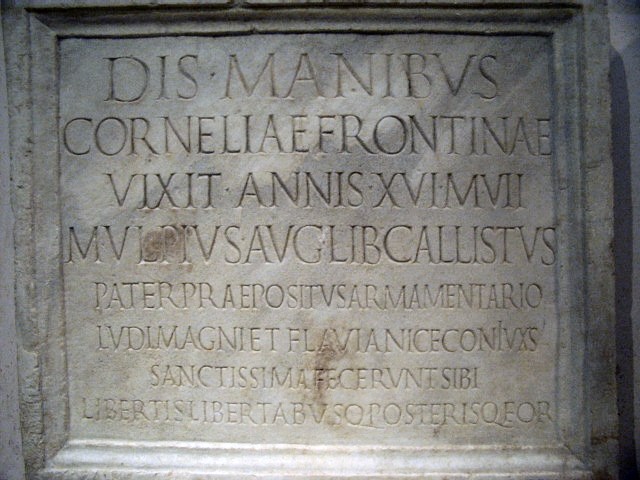
Roman Ghosts

Ave atque vale dis manibus

By Amy E. Barr

There’s a crisp feel in the air, your neighbors might be decorating their yard in zombie themes, and most people are planning on at least a slight uptick in sweet treats soon.  Now is the right time to serve up a seasonally appropriate topic of Classical ghosts. While Classical cultures generally enjoyed their occasional specters, it was the Romans who adored their ghost stories.

Now to clarify, I’m not talking about current Roman hauntings like this story from Hadrian’s Wall or this group of Roman soldiers sighted in 1953, York. The Romans themselves enjoyed ghosts of all sorts very much. They were also careful to tend their ghosts to keep them happy.

One of the best examples of ghosts with the most was the assortment from "the very helpful" di manes category that Vergil includes in the Aeneid. In book 1, we have Dido’s dead husband telling her to grab the gold and clear out quickly to found the city Carthage before her creepy brother could catch her. In book 2, we have a very grisly Hector telling Aeneas to wake up and leave Troy. Soon after that Aeneas’ (recently dead) wife, Creusa tells him to get a move on, thank you very much. Not satisfied with earthly specters, Vergil visits his hero to the di inferi and the fabulously eerie underworld (book 6), where Aeneas has an awkward conversation with recently dead Dido. Fortunately, Aeneas has a more fruitful exchange with dear-old-dead-dad who encourages him in fine Stoic fashion to follow his fates. Aeneas also runs into his freshly deceased helmsman who is in need of a nice burial.

That’s a pretty good body count! Clearly, Vergil considered ghosts to be the best way to advance a plot and hold a Roman audience. The Romans had certain rules about the type of dead person who might appear in dreams. Only friends and loved ones could pay a visit while you snoozed. When they did, they usually had dependable advice which should be immediately believed. Thus, Vergil describes these sorts of ghosts as extremely reliable sources of information.

Historian Pliny the Younger wrote this chilling ghost story, complete with rattling chains and a haunted house. This one serves as a good example of how properly level-headed Roman philosophers can help even an old dead guy, all while getting a great bargain on a house. My Latinists might want to try to translate this story from the Latin by visiting here.

Don't worry! Only improperly buried folks felt restless (and extra spooky) which made the Romans incredibly focused on the details of a proper burial. If you tended your dead well, the Romans reasoned, they would keep an eye on the whole family and even offer occasional advice. The friendly types were referred to as Di Manes. One would inscribe a memorial to them as dis minibus (or D.M., for short) which you can still see inscribed on even later Christian gravestones. The di manes were your friends and family but belonged to the larger category known as the di inferi, “those who live below.” 

February rather than October was the normal month for Romans to attend family graves which were all placed on the roads outside of town limits. If you ever visit Pompeii, be sure to take the path out of town to the Villa of the Mysteries to get a good look at the rows of Roman grades still in place there.


October 19, 2018

Old fashioned Diagramming, New Fashioned Comprehension


Do a little Google or Bing search and you’ll find a blog lamenting a sad plummet in basic grammar skills among modern English speakers. More times than not, the writer will opine that texting and tweeting are clearly to blame for the whole mess. After all, nobody is refining writing talents with “tnx ttyl omwh.” Any parent of a phone-owning teen must expect to master such mysteries quickly or miss the fact that your son just said, “Thanks, talk to you later. On my way home.”  I’m expected to respond with an appropriate emoji and count myself lucky that my teen remembers to text me when he starts his drive home. Is this playful form of communication to blame for the collapse of communications in the modern world? I say, “No!... At least not most of it.”

My middle school had three 6th grade English classes. Students were assigned randomly to one of the three. My teacher, it turns out, was on the verge of retirement. He insisted that he finish his career teaching grammar the same way he had always taught it. I remember that he explained this to all of us as we were handed some primeval old textbooks. The other two classes were taught by much younger educators who welcomed the state’s largess of shiny new workbooks and “cutting edge” language arts methodology.

All three educators were unknowingly participating in an accidental experiment that would be years in the making. Two taught English “by immersion.” This trendy “new” method meant students were given stacks of worksheets and tasked with circling nouns, verbs, and other important tidbits in random paragraphs. A job well done meant students knew their parts of speech.
My teacher taught sentence diagramming.  OHHH, sentence diagramming was SOOO last decade! 

The other teachers openly scoffed at him for it. He didn’t care. 30 awkward 6th graders were marched to the chalkboard to diagram sentences. By the end, we were fiercely competitive grammar tigers asking our teacher to throw us tougher and tougher challenges. Rawr.

That teacher retired soon after and sentence diagramming was no more. Language arts had modernized.

Fast forward to high school. Students were sorted into language arts classes once again but this time, with very few exceptions, the honors English program was populated by students from that old middle school sentence diagramming class.  Look at the top of the graduating class! Most were from that same middle school group. Most went on to some challenging college programs.

There is no mystery here. There’s a qualitative difference (to say the least) between learning to passively recognize what a noun looks like in random paragraphs and learning how the gears of English work, right down to the smallest mechanical elements. This is like the difference between a person who buys a watch because it is lovely and a person who is a watchmaker.  One recognizes beauty and can point out a few appealing features. The other can build the watch for himself or describe how another craftsman (Dickens, Longfellow, Shakespeare, Dickinson) built an even better masterpiece. Learning to diagram sentences makes you a watchmaker of English, not just a casual observer.

Over the next several months we at The Lukeion Project will be rolling out the first part of the print version of our celebrated Barbarian Diagrammarian™ program, which we continue to offer as a live synchronous spring semester class each year. We designed the Barbarian Diagrammarian™ program almost a decade ago when we discovered that most incoming high school students starting our Greek and Latin program needed help with English before they could hope to succeed at Latin or Greek. Very few had ever gone beyond being casual observers in their native tongue.

It isn’t enough to know the difference between a noun and a verb! What’s the difference between transitive and intransitive? Active and passive? Direct and indirect object? Adverbs vs. prepositions? Aspect vs. time? Dependent clauses introduced by subordinating conjunctions vs. relative clauses introduced by relative pronouns? Now considered advanced grammar, these foundational ideas used to be standard knowledge for middle school.


We are developing a multivolume self-paced program that will allow anyone, especially our middle school students, to become English masters. Expect our signature Barbarian Diagrammarian™ quirky style but now new and improved because story-telling and fantastic illustrations are the spoonful of sugar that will help the grammar go down. We brought a trial version of Volume I to our conferences this last summer and were thrilled to see students grab the book like it was a tasty new epic as they connected instantly with Leland the Barbarian and his buddy, Lambert. 

We’ll keep you posted as we get closer to pre-orders. For now, you should know there are only 6 seats left in our 2:15 PM ET Barbarian Diagrammarian spring 2019 semester class, so the Department of Shameless Self-Promotion says you should register right away or miss out.

October 12, 2018

3 Things your High-schooler needs for College Success

These Things May Not be What you Expect

Amy E. Barr

Everyone who teaches classes for The Lukeion Project has also taught (or is even currently teaching) at the college level. When we say our classes are college-prep, we don’t just mean they are a tad demanding and look good on a transcript. From the first day of our first semester-class, we have been preparing people to flourish in challenging academic environments. This includes everything from managing time well, to learning how to successfully self-advocate by communicating with instructors, to writing a properly analytical research paper.  

Through the years, Lukeion faculty periodically gather at the water cooler and have collectively grumbled and harrumphed about the following skills that are absolutely 200% necessary for best success in college:

1. Successful students know how to fail well. 

This is not to be confused with "fail a lot." 
Ask any modern collegiate professional and they’ll likely put this issue high on their list as well: Academic stakes have become so high and so expensive that many students and their parents feel they can't recover from even a minor academic failure!
Each semester a few of our students predictably withdraw immediately after earning their first low quiz score. Sometimes this happens at the very start of the semester. Worse, it even happens when most of the semester has already passed...sometimes after two semesters have passed. "Failure just isn't an option," they opine. But failure is always an option! Failure is also normal. Your student needs practice experiencing failure and productively recovering from it.
Giving up after a bad week or two was so rare a decade ago we used to be able to remember specific details. For example, I once had a student who quit Latin after the third semester because she scored a 96% instead of 97% on a weekly quiz. It was the first time she didn't earn an A+! Her mom withdraw her from the class, fully supportive of ending her daughter's Latin studies due to this "failure." Certainly, such extremes are rare but becoming less so each year. Such students will meander through 7 years of middle and high school without suffering, surviving, and growing from a single failure. They will have developed almost no life survival skills. Even the smallest failure will eventually bring a catastrophe of epic proportions.
The qualities needed to endure a setback and return stronger are summed up as “grit.” Students must know how to have a bad week or two and still land on their feet. Second chances, no firm deadlines, and daily do-overs may seem like a great way to keep your kid happy but, be careful! Persistently protecting a child from failure will do the worst type of damage. Shielding kids from failure will never develop confidence, self-esteem, or resilience but rob them of those things most cruelly.

2. Successful students have lots of practice in academic writing.

In elementary school, even the most hesitant writer can be induced to produce when assigned creative writing projects. Limericks are tons more fun than book reports so creative projects rule the day. 
Too often students are never transitioned to academic writing until very late in their high school years, if ever. Aside from a rare few classes in college, students will never again be asked to produce creative writing projects. Lab reports, academic essays, research projects, literary analyses, and peer critiques are on their college schedule. Students won’t be taught how to write these things in college. If they don't know what they are doing, they will be assigned to a remedial course (code for “expensive class that doesn’t count toward graduation”) or they will require long hours with a tutor at the writing lab. All of our literature courses, history, and Latin 3 and beyond (including Transition), have academic writing requirements to help grow these necessary skills. 

3. Successful students have good time management.

Help students move toward independence by quitting your job as manager early in the teen years. There are plenty of job openings available in mentoring. Mentor was a character developed by Homer in his epic, the Iliad. Athena, disguised as Mentor, helps teenaged Telemachus safely cross the bridge to adulthood with timely words of advice. The modern idea is no different. A mentor does not manage the phone, calendar, and computer while handling every detail of a child’s life. Instead, she offers timely guidance while the young person does the hard work of navigating life himself. 
Parents must let adolescents do the legwork and heavy lifting now while there’s a safety net in place. Let your teen make his own arrangements with employers, pack leaders, teachers, and tutors. Let him coordinate his own details to find rides, attend a class, or practice a sport. When illness strikes, let her ask for make-up extensions on her own--even when she has the sniffles and doesn't feel like writing that email. 
The biggest obstacle to practicing this skill is the well-meaning parent. If you are an excuse-maker (“he didn’t finish because he was tired”), a second-chance giver (“please let her take the missed quiz”), or an extension-granter (“he is pretty busy, so you should give him extra time”) you’ll likely have a student who struggles with time-management issues. Your teenager will expect extensions and second chances from everyone if he has always gotten them from you.   

October 5, 2018

So Your Child wants to Be a Classics Major…

What's Next?

Amy E. Barr

"To study Latin is to encounter face to face the smartest, funniest, most beautiful minds that have ever lived."
—R. J. Teller


“Have her take Latin,” they said. “It will be good for her,” they said. Now 4 years of Latin and a couple years of Greek later she wants to be a Classics major. Is she going to be living in my basement for the rest of her life?

Ok, nobody has ever phrased it just this way, but I can read it on your face when you visit me at my talks at homeschool conferences. What’s in store for a student who has become so passionate about Latin or Greek that she wants to major in it? Is this something you should encourage, or should you press hard to steer your student toward a nice reliable S.T.E.M. degree or maybe Communications? I often have students who eagerly desire to continue studying Classical languages but the "more knowledgeable adults" in their lives have told them they must concentrate on more “lucrative” college-prep choices. Is Classics really such a bad plan for college?

While, like all academic fields, a future in philology offers assurances of neither luxury nor lucre. Classical languages and a Classics degree will surely take your student down some amazing roads. Fortunately, I ignored my mother’s grumblings when I decided to be a Classical archaeologist and philologist. In these crucibles, I discovered a practical passion for teaching paired with hundreds of glorious adventures in Mediterranean archaeology. I needed both.

As we finish our thirteenth year of teaching live-online at The Lukeion Project, we now have students who already pursued in full or in part, continued college and graduate level education in philology. They are now professional writers, lawyers, professors, historians, archaeologists, lawyers, parents, police officers, videographers, and creative professionals, to name only a few. Since you don't personally know our students, you can find lists of notable people online who were Classics majors who went on to make significant contributions to the world. That's great, you say, but what do mere mortals “do” with a degree in Classics?

Lukeion students enjoy an advantage. They often know before college begins that they wish to either major or minor in Classics (sorry, not sorry). Most people won’t have the opportunity to even try Latin or Greek until college, normally as late as their junior year. Can you say 6-year undergraduate degree?

If you want to pursue Classics, you can earn a BA in Classics. Most of these are more interdisciplinary and include Latin, Greek, or both plus history, culture, art history, archaeology. If you earn a BA in Classical Languages (working toward proficiency in both Latin and Greek) you'll spend more time on just the languages. These undergraduate degrees equip students to teach at the pre-college level or to go on to graduate programs in religion (Greek), Medieval Studies (Late Latin), Archaeology, Philosophy, Ancient History, Art History, or Classics (both languages).

If you earn the BA in Classics, are you stuck with getting a graduate degree that specifically deals with Latin and or Greek or will the degree prepare you for other things? Classics has consistently been viewed as one of the strongest liberal arts degrees a student can earn. Classics majors are trained as skilled communicators in writing and speech plus they have been taught to think critically and express themselves analytically. Classics majors are naturally suited to graduate degrees in law, sciences, medicine, communications, journalism, and so much more. Ever heard of Jerry Brown, governor of CA? Raymond Teller of the famous magic team Penn and Teller? Ted Tuner? J.K. Rowling? All these famous communicators are Classics majors.

Want more? Go here.

Curiosity Beats Confidence

By Amy Barr with The Lukeion Project Is it true that there’s no such thing as a dumb question? Of course there are dumb questions. As a te...