Showing posts with label philology. Show all posts

May 6, 2019

Students: Your Language Studies Need Summer Care

It doesn't matter if you are 14 or 64, language studies at the mastery level will tax your will power and challenge your schedule. Learning any new language well takes time, effort, practice, and a bit of time management. Want to learn a new language? Practice daily through review, mnemonic devices, flash cards, translation, plus repetition. Setting up a ritual of a little daily review isn't SO hard during a regular school semester. Summer, however, is a different challenge. Let's face it: when given the choice to go swimming or go translating, not that many want to forego the fun stuff.

For most, summer promises at least a slightly lightened academic load or even a well-earned rest. The bad news? If your program, like many language programs, ends in May and starts again at the end of August or early September, you will take an entire semester away from your new language.

“Wait,” you say, “that’s the good news. I could use a little time off!"

Imagine a very young child learning to speak for the first time. She is doing well. She is crafting 5 or 6-word sentences as she adds new words to her vocabulary every day. Suddenly, nobody speaks to her for 16 weeks. In this theoretical situation, all her language momentum will halt. Missing the necessary practice she will soon lose many of her gains.  The impact of such a language “silence” would be huge! Even if you are not a very young child, when you are in the process of learning a new language, taking three months off can set you back more than you can imagine.

Maybe look at it this way: If a person labors to build momentum as he peddles a bike uphill, he won’t usually stop just as he hits a comfortable speed. If he does, his muscles must work much harder to start again and return to that momentum as the slope is now very steep. Hills and bikes, languages and summers...it pays if you don't stop!

Here are four things you can do during your summer break (or any break longer than two weeks) to keep your language studies alive and well (while keeping your free-time free). These are especially useful for the study of Latin and Greek as we teach at The Lukeion Project. With a little modification, they will work for modern spoken languages as well.

Tackle Short Translation Challenges 
This is the best way to give your language studies a little weekly attention. To continue to develop your new language, challenge-error-correction is the best approach. In other words, you must be able to translate a piece and check your accuracy immediately. Find short translation pieces that help you review the elements of your new language in manageable pieces. Check your work for accuracy regularly or very little will be gained and even much will be lost if you reinforce bad habits. Schedule about an hour each time. I recommend you accomplish this challenge early in the day before other tasks fill up your schedule.

Flash Cards / Charts (Paradigms)
Reviewing individual data points as well as whole organized elements of your new language is a discipline that pays big dividends. Take Latin for example. After first year Latin, a student could make a rotating list of declensions (we know three at the end of the first year) and all the forms of the active voice indicative plus half the forms of the passive voice. Don’t forget your vocabulary! Now, assign yourself a little review every few days. Maybe no more than 45 good uninterrupted (social-media-free) minutes are necessary per week. Reward yourself with a nice incentive if you can fully focus on the data for all 45 minutes.

Language Puzzles
It doesn't matter what language you are learning, there are hundreds of different "puzzles" designed to help you review your language in a fun way. Google Latin crossword puzzles, Sudoku for Roman numerals, Latin cartoons, and much more. Consider translating any of the popular modern works that have been translated into your chosen language. Examples in Latin are Winnie Ille Pu, Harius Potter, Hobitus Ille, and many more.

Alternate Sources of Inspiration
Do a little digging. Maybe you like science or biology. Maybe archaeology, inscriptions, or numismatics are all your thing. Perhaps you want to check out law, debate, or forensics. Learn how to write cool Latin mottos if you adore art. Is the study of medicine in your future? Look for applications of your language studies in ways that interest you. Latin (and Greek) has a role in almost everything. Spend a little time this summer finding ways it has impacted subjects you enjoy.

November 2, 2018

More Keys to Memorization

Quid dicam de thesauro rerum omnium memoria?
What shall I say of memory, the repository of all knowledge? 

(Cicero - De senectute)

by Amy E. Barr

Homer, many would argue,* was the composer of the Iliad, an epic describing the almost final days of the Trojan war. I say “composer” nor writer because it is unlikely he had the luxury of being able to write down those 24 books of Greek poetry in dactylic hexameter since the Greek alphabet was still on the drafting table. Even if he was able to enjoy a beta test on that new Greek alphabet, he was blind, so there’s that.  Homer also composed and recited the Odyssey, the tale of Odysseus’ struggle to get home, in much the same way: all from memory. Both epics are 24 books written in meter (an arrangement of long and short syllabus) rather than rhyme.
*It is common for some to sneer that the Iliad and Odyssey were written by committee and perfected gradually over time rather than composed by Homer. First, I hate people that sneer but, second, I’ve never seen a convincing argument for how a committee would be able to write a better epic than a single author. These sneering types probably actually enjoy committee meetings. I bet they are the ones that regularly schedule them on Fridays before holidays. 

My point is this: Homer composed and recited and then MEMORIZED very long epics. As one might imagine, the need to memorize these epics (and others from this same early period) lasted quite a while until that Greek alphabet finished up the GoFundMe period and eventually launched. Even then, memorization continued. As an educated Greek or Roman person, one memorized parts, or even all of these epics, plus plenty more.

Memorizing fast amounts of information used to be standard. What happened to us? I think we forgot how the brain can do amazing things! While there are plenty of techniques you can use to memorize large quantities of information, I recommend two that everyone can use right away: writing and sleeping. Sleep is a fabulous study aid as long as you are not sleeping through the block of time scheduled study.

Rewire Your Brain Every Day 
Daily study alternating with other normal activities and a full night's sleep is the best stress-free way to soak up something complicated like Latin. I’ll use Latin as my example because I am a Latin teacher. These techniques work for anything complicated.  Try this: Spend about 8-12 minutes on vocabulary right before you go to sleep EVERY night. Your brain will work on it all night for you while you get some quality snoozing done. First thing in the morning, zoom through your deck once more. You’ll find your retention is pretty good! Your brain chewed on those facts for you all night.
Next, look at a chart of endings or forms that you taped to your bathroom mirror, just think them through while you are brushing your teeth. Then make yourself write them out quickly on a piece of scrap paper from memory. When you are riding in a car, spend 10 minutes flipping through flash cards or getting to know some noun or verb endings. Short study periods. No late-nighters.

LONG CRAM SESSIONS ARE A WASTE OF TIME
Cram sessions (when you sit for extended periods trying to ‘cram’ knowledge into your brain right before the test) don’t work. This rule is true for any complex body of knowledge like math formulae or points of history or scientific names for seaweed. Break up your study sessions into short periods (20 to 30 minutes) that are never longer than 45 minutes to an hour. Even on a day off, do 15 minutes of study (I like a ton of homemade flash cards or reading the chapter), but do this especially before you go to bed. I recommend that you involve as much writing and rewriting as possible. Got a stack of principal parts to learn? Tell yourself you can go to bed after you’ve written them all five times each.
People who play instruments are already familiar with this mastery method which is why musicians tend to be really good Latin learners. “Music makes you smarter” because it teaches you how to learn. Constant practice and repitition does the job in music and in language.

Use all your senses
You might be surprised to hear this, but I’m not a proponent of approaches that have you mindlessly chanting Latin all day. Most of those Latin learning systems don’t teach you much except for how to make an hour boring while your dog or cat looks at you funny. There IS, however, something to be said for employing multiple senses to memorize things. So chanting (or drawing, or writing, or listening) can be a great tool depending on your learning style. Most of us benefit from the simple act of writing things out because slowing the brain to carefully compose letters on paper is a big boon to mastery.
Just like you wouldn’t lift weights with only one arm, why study only one way? Work out different parts of your brain by using all your senses to memorize. Get creative:  Read, write, draw, doodle, pronounce, even act out your data list. Some attempt to write a story in Latin each week using that chapter’s vocabulary correctly. This technique can be done for most subjects.

Some create a pictorial system for flash cards, drawing a doodle for a term to help cement a concept visually. Others enlist a study buddy who is willing to help wflashcardssh cards on a regular basis. 
Remember, study some every day, write things out, and get a good night of rest. Your brain will double your efforts for you!

October 26, 2018

Roman Ghosts

Ave atque vale dis manibus

By Amy E. Barr

There’s a crisp feel in the air, your neighbors might be decorating their yard in zombie themes, and most people are planning on at least a slight uptick in sweet treats soon.  Now is the right time to serve up a seasonally appropriate topic of Classical ghosts. While Classical cultures generally enjoyed their occasional specters, it was the Romans who adored their ghost stories.

Now to clarify, I’m not talking about current Roman hauntings like this story from Hadrian’s Wall or this group of Roman soldiers sighted in 1953, York. The Romans themselves enjoyed ghosts of all sorts very much. They were also careful to tend their ghosts to keep them happy.

One of the best examples of ghosts with the most was the assortment from "the very helpful" di manes category that Vergil includes in the Aeneid. In book 1, we have Dido’s dead husband telling her to grab the gold and clear out quickly to found the city Carthage before her creepy brother could catch her. In book 2, we have a very grisly Hector telling Aeneas to wake up and leave Troy. Soon after that Aeneas’ (recently dead) wife, Creusa tells him to get a move on, thank you very much. Not satisfied with earthly specters, Vergil visits his hero to the di inferi and the fabulously eerie underworld (book 6), where Aeneas has an awkward conversation with recently dead Dido. Fortunately, Aeneas has a more fruitful exchange with dear-old-dead-dad who encourages him in fine Stoic fashion to follow his fates. Aeneas also runs into his freshly deceased helmsman who is in need of a nice burial.

That’s a pretty good body count! Clearly, Vergil considered ghosts to be the best way to advance a plot and hold a Roman audience. The Romans had certain rules about the type of dead person who might appear in dreams. Only friends and loved ones could pay a visit while you snoozed. When they did, they usually had dependable advice which should be immediately believed. Thus, Vergil describes these sorts of ghosts as extremely reliable sources of information.

Historian Pliny the Younger wrote this chilling ghost story, complete with rattling chains and a haunted house. This one serves as a good example of how properly level-headed Roman philosophers can help even an old dead guy, all while getting a great bargain on a house. My Latinists might want to try to translate this story from the Latin by visiting here.

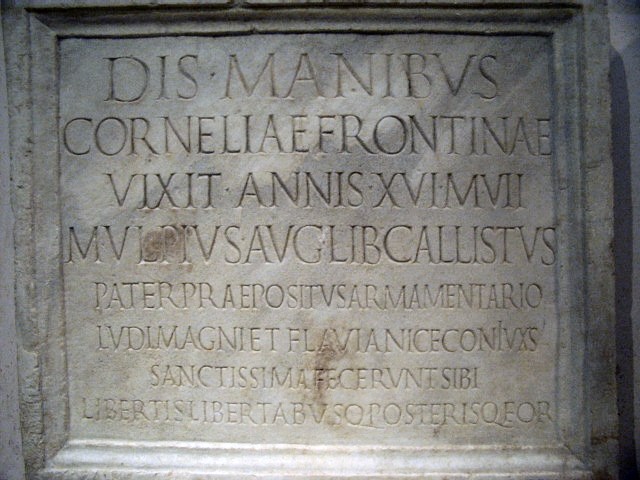
Don't worry! Only improperly buried folks felt restless (and extra spooky) which made the Romans incredibly focused on the details of a proper burial. If you tended your dead well, the Romans reasoned, they would keep an eye on the whole family and even offer occasional advice. The friendly types were referred to as Di Manes. One would inscribe a memorial to them as dis minibus (or D.M., for short) which you can still see inscribed on even later Christian gravestones. The di manes were your friends and family but belonged to the larger category known as the di inferi, “those who live below.” 

February rather than October was the normal month for Romans to attend family graves which were all placed on the roads outside of town limits. If you ever visit Pompeii, be sure to take the path out of town to the Villa of the Mysteries to get a good look at the rows of Roman grades still in place there.


October 19, 2018

Old fashioned Diagramming, New Fashioned Comprehension


Do a little Google or Bing search and you’ll find a blog lamenting a sad plummet in basic grammar skills among modern English speakers. More times than not, the writer will opine that texting and tweeting are clearly to blame for the whole mess. After all, nobody is refining writing talents with “tnx ttyl omwh.” Any parent of a phone-owning teen must expect to master such mysteries quickly or miss the fact that your son just said, “Thanks, talk to you later. On my way home.”  I’m expected to respond with an appropriate emoji and count myself lucky that my teen remembers to text me when he starts his drive home. Is this playful form of communication to blame for the collapse of communications in the modern world? I say, “No!... At least not most of it.”

My middle school had three 6th grade English classes. Students were assigned randomly to one of the three. My teacher, it turns out, was on the verge of retirement. He insisted that he finish his career teaching grammar the same way he had always taught it. I remember that he explained this to all of us as we were handed some primeval old textbooks. The other two classes were taught by much younger educators who welcomed the state’s largess of shiny new workbooks and “cutting edge” language arts methodology.

All three educators were unknowingly participating in an accidental experiment that would be years in the making. Two taught English “by immersion.” This trendy “new” method meant students were given stacks of worksheets and tasked with circling nouns, verbs, and other important tidbits in random paragraphs. A job well done meant students knew their parts of speech.
My teacher taught sentence diagramming.  OHHH, sentence diagramming was SOOO last decade! 

The other teachers openly scoffed at him for it. He didn’t care. 30 awkward 6th graders were marched to the chalkboard to diagram sentences. By the end, we were fiercely competitive grammar tigers asking our teacher to throw us tougher and tougher challenges. Rawr.

That teacher retired soon after and sentence diagramming was no more. Language arts had modernized.

Fast forward to high school. Students were sorted into language arts classes once again but this time, with very few exceptions, the honors English program was populated by students from that old middle school sentence diagramming class.  Look at the top of the graduating class! Most were from that same middle school group. Most went on to some challenging college programs.

There is no mystery here. There’s a qualitative difference (to say the least) between learning to passively recognize what a noun looks like in random paragraphs and learning how the gears of English work, right down to the smallest mechanical elements. This is like the difference between a person who buys a watch because it is lovely and a person who is a watchmaker.  One recognizes beauty and can point out a few appealing features. The other can build the watch for himself or describe how another craftsman (Dickens, Longfellow, Shakespeare, Dickinson) built an even better masterpiece. Learning to diagram sentences makes you a watchmaker of English, not just a casual observer.

Over the next several months we at The Lukeion Project will be rolling out the first part of the print version of our celebrated Barbarian Diagrammarian™ program, which we continue to offer as a live synchronous spring semester class each year. We designed the Barbarian Diagrammarian™ program almost a decade ago when we discovered that most incoming high school students starting our Greek and Latin program needed help with English before they could hope to succeed at Latin or Greek. Very few had ever gone beyond being casual observers in their native tongue.

It isn’t enough to know the difference between a noun and a verb! What’s the difference between transitive and intransitive? Active and passive? Direct and indirect object? Adverbs vs. prepositions? Aspect vs. time? Dependent clauses introduced by subordinating conjunctions vs. relative clauses introduced by relative pronouns? Now considered advanced grammar, these foundational ideas used to be standard knowledge for middle school.


We are developing a multivolume self-paced program that will allow anyone, especially our middle school students, to become English masters. Expect our signature Barbarian Diagrammarian™ quirky style but now new and improved because story-telling and fantastic illustrations are the spoonful of sugar that will help the grammar go down. We brought a trial version of Volume I to our conferences this last summer and were thrilled to see students grab the book like it was a tasty new epic as they connected instantly with Leland the Barbarian and his buddy, Lambert. 

We’ll keep you posted as we get closer to pre-orders. For now, you should know there are only 6 seats left in our 2:15 PM ET Barbarian Diagrammarian spring 2019 semester class, so the Department of Shameless Self-Promotion says you should register right away or miss out.

October 12, 2018

3 Things your High-schooler needs for College Success

These Things May Not be What you Expect

Amy E. Barr

Everyone who teaches classes for The Lukeion Project has also taught (or is even currently teaching) at the college level. When we say our classes are college-prep, we don’t just mean they are a tad demanding and look good on a transcript. From the first day of our first semester-class, we have been preparing people to flourish in challenging academic environments. This includes everything from managing time well, to learning how to successfully self-advocate by communicating with instructors, to writing a properly analytical research paper.  

Through the years, Lukeion faculty periodically gather at the water cooler and have collectively grumbled and harrumphed about the following skills that are absolutely 200% necessary for best success in college:

1. Successful students know how to fail well. 

This is not to be confused with "fail a lot." 
Ask any modern collegiate professional and they’ll likely put this issue high on their list as well: Academic stakes have become so high and so expensive that many students and their parents feel they can't recover from even a minor academic failure!
Each semester a few of our students predictably withdraw immediately after earning their first low quiz score. Sometimes this happens at the very start of the semester. Worse, it even happens when most of the semester has already passed...sometimes after two semesters have passed. "Failure just isn't an option," they opine. But failure is always an option! Failure is also normal. Your student needs practice experiencing failure and productively recovering from it.
Giving up after a bad week or two was so rare a decade ago we used to be able to remember specific details. For example, I once had a student who quit Latin after the third semester because she scored a 96% instead of 97% on a weekly quiz. It was the first time she didn't earn an A+! Her mom withdraw her from the class, fully supportive of ending her daughter's Latin studies due to this "failure." Certainly, such extremes are rare but becoming less so each year. Such students will meander through 7 years of middle and high school without suffering, surviving, and growing from a single failure. They will have developed almost no life survival skills. Even the smallest failure will eventually bring a catastrophe of epic proportions.
The qualities needed to endure a setback and return stronger are summed up as “grit.” Students must know how to have a bad week or two and still land on their feet. Second chances, no firm deadlines, and daily do-overs may seem like a great way to keep your kid happy but, be careful! Persistently protecting a child from failure will do the worst type of damage. Shielding kids from failure will never develop confidence, self-esteem, or resilience but rob them of those things most cruelly.

2. Successful students have lots of practice in academic writing.

In elementary school, even the most hesitant writer can be induced to produce when assigned creative writing projects. Limericks are tons more fun than book reports so creative projects rule the day. 
Too often students are never transitioned to academic writing until very late in their high school years, if ever. Aside from a rare few classes in college, students will never again be asked to produce creative writing projects. Lab reports, academic essays, research projects, literary analyses, and peer critiques are on their college schedule. Students won’t be taught how to write these things in college. If they don't know what they are doing, they will be assigned to a remedial course (code for “expensive class that doesn’t count toward graduation”) or they will require long hours with a tutor at the writing lab. All of our literature courses, history, and Latin 3 and beyond (including Transition), have academic writing requirements to help grow these necessary skills. 

3. Successful students have good time management.

Help students move toward independence by quitting your job as manager early in the teen years. There are plenty of job openings available in mentoring. Mentor was a character developed by Homer in his epic, the Iliad. Athena, disguised as Mentor, helps teenaged Telemachus safely cross the bridge to adulthood with timely words of advice. The modern idea is no different. A mentor does not manage the phone, calendar, and computer while handling every detail of a child’s life. Instead, she offers timely guidance while the young person does the hard work of navigating life himself. 
Parents must let adolescents do the legwork and heavy lifting now while there’s a safety net in place. Let your teen make his own arrangements with employers, pack leaders, teachers, and tutors. Let him coordinate his own details to find rides, attend a class, or practice a sport. When illness strikes, let her ask for make-up extensions on her own--even when she has the sniffles and doesn't feel like writing that email. 
The biggest obstacle to practicing this skill is the well-meaning parent. If you are an excuse-maker (“he didn’t finish because he was tired”), a second-chance giver (“please let her take the missed quiz”), or an extension-granter (“he is pretty busy, so you should give him extra time”) you’ll likely have a student who struggles with time-management issues. Your teenager will expect extensions and second chances from everyone if he has always gotten them from you.   

October 5, 2018

So Your Child wants to Be a Classics Major…

What's Next?

Amy E. Barr

"To study Latin is to encounter face to face the smartest, funniest, most beautiful minds that have ever lived."
—R. J. Teller


“Have her take Latin,” they said. “It will be good for her,” they said. Now 4 years of Latin and a couple years of Greek later she wants to be a Classics major. Is she going to be living in my basement for the rest of her life?

Ok, nobody has ever phrased it just this way, but I can read it on your face when you visit me at my talks at homeschool conferences. What’s in store for a student who has become so passionate about Latin or Greek that she wants to major in it? Is this something you should encourage, or should you press hard to steer your student toward a nice reliable S.T.E.M. degree or maybe Communications? I often have students who eagerly desire to continue studying Classical languages but the "more knowledgeable adults" in their lives have told them they must concentrate on more “lucrative” college-prep choices. Is Classics really such a bad plan for college?

While, like all academic fields, a future in philology offers assurances of neither luxury nor lucre. Classical languages and a Classics degree will surely take your student down some amazing roads. Fortunately, I ignored my mother’s grumblings when I decided to be a Classical archaeologist and philologist. In these crucibles, I discovered a practical passion for teaching paired with hundreds of glorious adventures in Mediterranean archaeology. I needed both.

As we finish our thirteenth year of teaching live-online at The Lukeion Project, we now have students who already pursued in full or in part, continued college and graduate level education in philology. They are now professional writers, lawyers, professors, historians, archaeologists, lawyers, parents, police officers, videographers, and creative professionals, to name only a few. Since you don't personally know our students, you can find lists of notable people online who were Classics majors who went on to make significant contributions to the world. That's great, you say, but what do mere mortals “do” with a degree in Classics?

Lukeion students enjoy an advantage. They often know before college begins that they wish to either major or minor in Classics (sorry, not sorry). Most people won’t have the opportunity to even try Latin or Greek until college, normally as late as their junior year. Can you say 6-year undergraduate degree?

If you want to pursue Classics, you can earn a BA in Classics. Most of these are more interdisciplinary and include Latin, Greek, or both plus history, culture, art history, archaeology. If you earn a BA in Classical Languages (working toward proficiency in both Latin and Greek) you'll spend more time on just the languages. These undergraduate degrees equip students to teach at the pre-college level or to go on to graduate programs in religion (Greek), Medieval Studies (Late Latin), Archaeology, Philosophy, Ancient History, Art History, or Classics (both languages).

If you earn the BA in Classics, are you stuck with getting a graduate degree that specifically deals with Latin and or Greek or will the degree prepare you for other things? Classics has consistently been viewed as one of the strongest liberal arts degrees a student can earn. Classics majors are trained as skilled communicators in writing and speech plus they have been taught to think critically and express themselves analytically. Classics majors are naturally suited to graduate degrees in law, sciences, medicine, communications, journalism, and so much more. Ever heard of Jerry Brown, governor of CA? Raymond Teller of the famous magic team Penn and Teller? Ted Tuner? J.K. Rowling? All these famous communicators are Classics majors.

Want more? Go here.

September 28, 2018

5 Best Ways to Memorize Tricky Things

Everyone Can Have this Superpower

Amy E. Barr, The Lukeion Project

"To observe attentively is to remember distinctly." ~Edgar Allan Poe


Being able to memorize tricky things is better than a superpower. Only a few people get to have super powers and super suits, but nearly anyone can learn how to memorize tricky things. Sure, shape-shifting and mega-strength will make you more popular at parties, but memorization skills can take you from a mild-mannered denizen of dull to a rocket scientist, brain surgeon, brilliant botanist, or illustrious archaeologist.

Stylish modern pedagogy (a fancy term for teaching techniques) has turned a pouty frown towards this old skill, to the detriment of all. Teachers are taught to promote using “tools” instead of boring old-fashioned memorization. “Why waste brain space on memorization,” they argue, “if you can learn to master tools like computers and search engines?’

Can you imagine Sherlock Holmes or Hercule Poirot asking the inspector to wait a few minutes while he checks his smartphone for information? Can you imagine your surgeon needed to pause every few minutes during a life-saving procedure to look stuff up online? What would have happened to the Iliad and Odyssey if Homer had not been able to memorize all those lines of epic poetry he'd composed in his mind?

This time of year at The Lukeion Project, we have our Witty Wordsmith, Latin 1, and Greek 1 students coming to--for many--their very first big memorization challenge. Most survive admirably. Others? Not so much! 

Fret no more! Here are the top FIVE ways to start memorizing tricky things right now:

1.  Repeat it

This seems like an obvious first step but if you are new to memorizing things you may be unaware of how MUCH repetition is needed. It takes, on average, 8 exposures to a new vocabulary word before you recognize it at all, much less with speed. Parents: If your learner sits down to a digital deck of vocabulary cards once and performs poorly on the quiz, there’s nothing wrong with your child’s brain but there is something wrong with her methods. It takes 5 to 10 repetitions with a hand-printed paper deck of flash cards that can be shuffled, flipped, and shuffled again to get the job done.

2. Sense it

Gone are the days when chanting alone helps anyone but the small minority known as audio learners. Audio learners were once the majority in the screenless, computer-less, YouTube-less days of yore. Visual learners rule today, and they need to use more senses, especially the ones that employ their eyes. If you have something to memorize, draw it, write it, speak it, illustrate it, journal it, demonstrate it.

3. Teach it

If you are a homeschool parent, this one should be obvious. If you have been homeschooling for a while you know how much you are learning (we’ll say “re-learning”) from all those years of being a passive listener in a school desk. Teaching tricky things to others will force you to learn those tricky things quickly. If your shy little thing doesn’t want to teach it, have him journal it, write out an explanation as if he were sending a letter to a student.

4. Shuffle it

Ever notice when you want to alphabetize things you find yourself singing the Alphabet Song? When our students learn Latin or Greek, they must learn a lot of information that is initially presented in chart forms such as the endings of a noun or the forms of a verb. We call these paradigms. Many learners can reproduce a paradigm perfectly but utterly fail to recognize the various components of that paradigm when translating an actual sentence or recognizing a word form joined to another Greek or Latin stem. Always turn the various parts of each chart into separate flash cards to aid the student in rapid identification outside of chart form. Students must recall the individual parts of a paradigm to make use of those parts. Therefore, we don’t promote a ton of those cute memorization songs. Students can learn a zippy tune but none of that helps if they can’t pull apart the smallest pieces of the puzzle.

5.  Visualize & vocalize it


Rapidly build your brain’s storehouse of tricky things by associating visual cues with new words. This can be as basic as making all nouns in your deck a certain color while prepositions are another. Artistic students might draw a little doodle. Anyone can pair a visual idea of a word or grammar concept as they memorize it. Don’t leave out SAYING the word to yourself even as you visualize it. In the first assignment of Latin 1 the textbook includes a Latin sentence with the Latin word labor. You would be surprised by how many students send me a distressed note complaining this word is not in their vocabulary list and they have no idea what it means. I invariably tell them, “say it aloud and see if that helps.” It always does. 

Latin is Different

By Amy Barr with The Lukeion Project I was browsing around in a Classical education online group the other day when a Latin pedagogy quest...