Showing posts with label mythology. Show all posts

October 11, 2021

Fascinating & Apotropaic

 Weird Squash, Odd Jewelry

By Amy Barr with The Lukeion Project

Apotropaic comes from Greek αποτρέπειν "to ward off." It comes from από- "away" and τρέπειν "to turn,” specifically “to ward off evil.” Every world culture has a superstitious quirk or two that people employ in an effort to ward off evil (or maybe even bring good luck). True to human nature, we might think our grandmother’s admonition to avoid walking under ladders or opening umbrellas in the house sounds as normal as decorating the barn with a lucky horseshoe. We are less likely to accept superstitious quirks from other cultures as normal, so I have collected a few here to entertain us all.

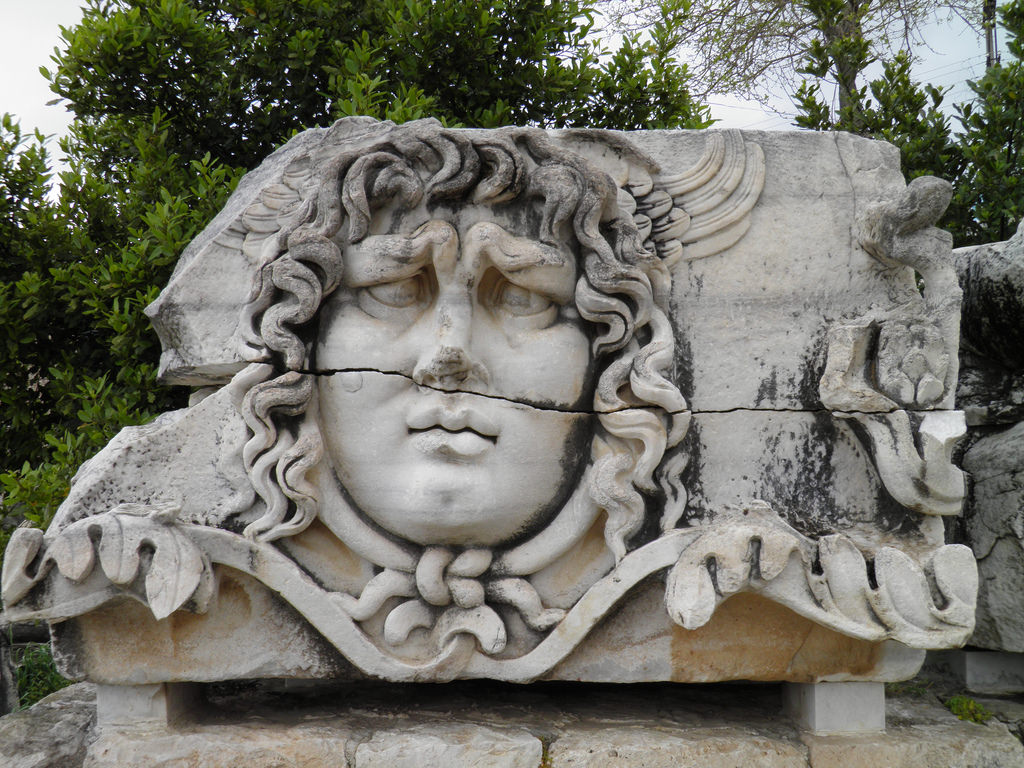
If one wanted to ward off evil in ancient Greece, one would decorate clothes, buildings, or jewelry with the face of a gorgon to stop evil in its tracks just like Medusa could drop you dead like a rock with just one glance. The gorgon’s face was not pleasant. It had fangs, wild eyes, a protruding tongue, and unruly hair. Now that I think about it, this also describes me before I have had some coffee in the morning.

A gorgon’s face was a standard ornament for armor but also used in architecture, clothing, rugs, and jewelry. According to standard mythology, the Greek goddess Athena put on her dad’s favorite jacket, the Aegis, and then decorated it with a gorgon’s face as a fitting example to humans about the proper way to turn away evil while dressing well.

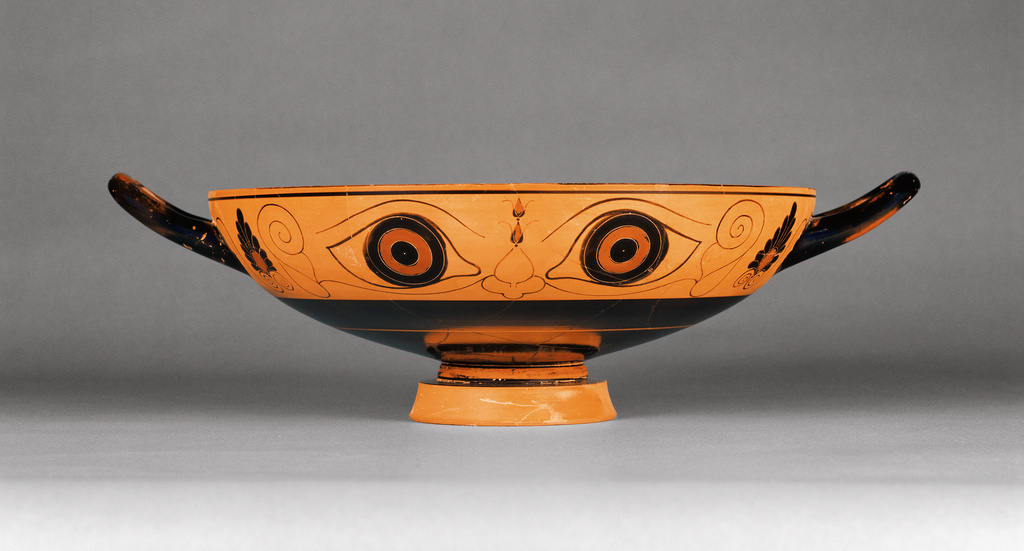
Likely related to the scary gorgon’s face was the representation of eyes, either as a set or singleton, to intimidate evil. Drawing a single eye was much easier than illustrating a gorgon. For the art impaired, drawing an eye was a cheap, fast, easy means to ward off malevolent glares. In ancient Greece there were eyes on cups (lest one swallow evil) and ships (shipwrecks were a big problem). If you visit modern Greece or much of the eastern Mediterranean, you will see a similar symbol adorning everything from buses and homes to fine jewelry. The iconic Mati or blue eye often appears in a lovely Aegean blue glass (much nicer than the fanged googly-eyed original). These make a lovely way to give evil the boot.

The Romans chased off evil or envious glances with jokes and funny pictures. Both the Greeks and Romans used images or charms of (ehem) a certain body part to scare away evil. These charms – often used for earrings, lamps, or necklaces—were called fascinum/fascina. The term “fascinating” comes from the name of these (ehem) charms. The term was meant to imply that one had been put under a spell. The term may or may not have anything to do with the fasces, the bundle of rods and an ax carried by lictors before the Roman consul. Fasces, not fascina, led to the modern term “fascism.”

Meanwhile, back to scary faces: gargoyles were ugly enough to scare evil away from important buildings in Europe. The English term “hunky punk” described grotesque scary carved architectural bits, but I think it might fit for some members of boy bands.


If one wanted an affordable home-spun ugly carved-thing, turnips did the trick for many years. Thankfully, turnips are as difficult to carve as they are to eat so other fruits or vegetables cycled through the list of options. Celts adopted winter cucurbits (squash, melons, etc) as an easier way to scare away evil since they were available right after harvest when people celebrated the new year.

The idea of apotropaic fall fruits resonated well in the early colonies of the United States where settlers needed some extra good luck. North American tribes gave us the names for squash (a Massachusett word, askꝏtasquash or a Narragansett word, askútasquash) and pumpkin (Massachusett pôhpukun meaning “grows forth round”). 

Growers are happy to offer every type of pumpkin, squash, and gourd for the purpose carving and stacking while (thankfully) turnips fell out of style. These carve-worthy fruits make tasty pies for Thanksgiving plus delicious roasted the seeds!


September 21, 2020

Three Myths about Learning Classical Mythology

Let's Talk Myth Congeniality

By Amy E. Barr, The Lukeion Project

Decorative
Ah! Classical Mythology! I’ve offered a course on the subject for more than a decade. This is the first year I’ve taken a break. Students love to read vivid tales of heroes, monsters, and adventure. Parents love to see their kids learning more about vocabulary, history, and writing while they grow to love good literature. Soon students become thirsty to read more, explore ancient art, search for Classical themes in music, and maybe even go see a Greek tragedy or start their own Classically inspired writing projects. What’s not to like about a course in Classical Mythology? Yet, this tends to be a course with ridiculously small enrollment even though those that do join the class, love it. 

I have a theory. I think a few too many people believe a few of these myths about Classical mythology.

Myth #1: Classical mythology is childish and is best for young students.

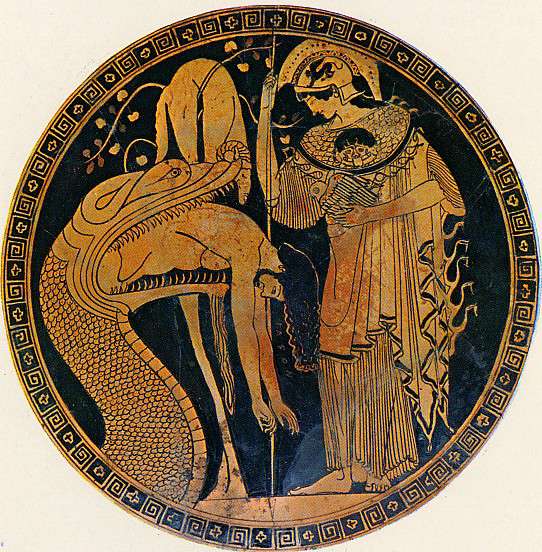
Indulge your imagination with tales of Jason and the Argonauts as they outwit the serpent and steal the Golden Fleece. Construe your own heroic escapes from the Cyclops, Cerberus, and Charybdis. Cheer or boo the crafty Greeks as they outwit the Trojans with a wooden horse. Rick Riordan has a huge following of young fans who adore how he’s applied Classical mythology to the fictional lives of modern teenage heroes. These stories are a lot of fun, but can mythology bring more to the table for older students than fluffy entertainment?

Outside the sporadic head-sprouting Hydra, man-eating turtle, or deadly gorgon, the subject matter of Classical literature requires the maturity of a student who is well into the logic stage and is ready to express himself coherently as he reasons through the complexities of the story at hand. A younger student can memorize scads of mythological names, get a kick out of Odysseus outwitting the Cyclops, or cheer on Theseus fighting the Minotaur. Yet the younger student will likely misinterpret Achilles’ rage, fail to understand Hecuba’s desolation, misconstrue Clytemnestra’s revenge, and miss the mark on Oedipus’ hubris. Simply put, most Classical stories are PG-13. 

Older students love to wrestle with the complex dilemmas posed by myths in Classical literature. Did Penelope’s suitors deserve their fate based on the mores of the ancient guest-host relationship? Why did Theseus grow suddenly absent-minded as he abandoned Ariadne? Was Achilles justified in all that rage? Did Oedipus deserve his cruel fate? 

Save mythology for your high school learners who crave weighing in on life’s bigger questions. Your teenagers will love to debate the weightier questions of Classical mythology even while enjoying a few violent cyclops stories.

Myth #2: Classical Mythology isn’t an appropriate subject for persons of faith.

One time I was in my booth at a homeschool conference when one very angry woman stormed up to me and asked if I taught Classical mythology. I’d never had anyone angry at me for this sort of thing but when I said yes, she glared and snorted, “I can’t believe people still believe in the Olympian gods.” 

She spun and left in a huff.

She must think the strangest things about historians, science fiction writers, literature teachers, and artists of all types.

Despite some admittedly problematic decisions by those Olympians, many notable scholars and authors of faith have been experts in Classical literature. A quote credited to C. S. Lewis sums things up nicely, "I believe Christianity as I believe the sun has risen, not because I see it, but because by it I see everything else." Lessons of courage, hospitality and loyalty can inform and instruct as well as tales of greed, pride, and cowardice. The vast range of Classical literature has inspired authors from Augustine to Shakespeare, from Twain and Tolkien to our C. S. Lewis who himself who wrote poems, essays, and elegant epics with strong Classical underpinnings. 

Myth #3:  Classical mythology isn’t a good use of precious busy high school time

I saved this for last since it is one that many hardworking home educators fervently believe (because it’s the one I hear quite often). With an impossible schedule of duel enrollment and 3 AP classes, I find a lot of students skip the study of Classical literature because they think it isn’t particularly useful for serious-minded folks trying to get into a serious-minded college. Likewise, students who are not planning on the college path are expected to grind away on the same topics that have failed to inspire before so they can tick boxes and be done. 

“Mythology,” mom says, “won’t help you finish your math and science diploma requirements nor get you into college.”  

Mythology in Classical literature may be one of the most practical topics a high school student can study. Hear me out: Greek and Latin word roots and origins found in mythology will open wide the potential for English word power. Mastering Greek and Latin literature will pull back the velvet curtain on the currently maligned Western Civilization. Virtues like courage, hospitality, civic duty, and hard work are exemplified in these ancient tales. Concepts like liberty, responsibility, perseverance, and loyalty abound. Nearly every great literary work has been inspired by the Classical world in some way. Skipping Classical literature is like pulling half the blocks out of a building’s foundation. That building may not fall, but it will surely be rendered useless and flimsy during toughter times.

Once considered an essential part of an excellent education, mythology in Classical literature has now been consigned to the academic discard pile by public, private, and home educators alike. Shifting perceptions about education have pushed it out of the way out to make room for more math and science. 

Ignorance about Classical literature will narrow one’s perspective and can make the mind’s terrain a tad barren. Encourage your high school student to take on the intellectual challenge of a good Greek tragedy, a finely worded epic, or even a suspiciously funny retelling by Ovid.  You never know where his interests might lead him; maybe he’ll be this generation’s Aristotle, Shakespeare, Tolkien, or C. S. Lewis.

Lukeion Students: Mythology took a short vacation during the 2020-2021 academic year at The Lukeion Project. Look for the new version to roll out for the 2021-2022 academic year under the genius tutelage of Dr. Fisher, Muse. 

October 18, 2019

Plan for AP Latin from the Start


By Amy Barr at The Lukeion Project

At The Lukeion Project, we offer AP Latin in our fourth-year Latin class after students have had a chance to complete their grammar years (Latin I and II with us) and a full year of Latin readings (Latin III). Students who make good progress in Latin will cross that golden finish line during their junior or senior year, depending on when they started Latin with us. The AP Latin Exam typically tests a student over the translation and close readings of two authors (Caesar and Vergil) as would be typical in a second-year college Latin course. This makes success on a single AP exam worth ticking four semesters at college off the "to-do" list.

Many students join our program after starting Latin elsewhere. Unfortunately, some super teacher-friendly Latin approaches on the market don’t offer enough Latin syntax, grammar, and language mechanics to carry a student into reading the real stuff. Obviously, some of our own students feel the need for a little more Latin review before moving into our third-year program. The solution? Offer a Transition course to give students who need it one more chance to fill in any gaps before moving into a translation-heavy Latin III course. If students have time in their schedule, this can be a good option for many students. Those who feel their Latin is pretty strong, we offer additional years of Latin study after AP Latin, including Cicero, Ovid, and now Terence.

So, students who would like to try their hand at AP Latin should already be reasonably competent in Latin translation as they start the course. What else do they need to succeed?

A College Board approved AP Latin course dictates the Latin that the class must read as well as a range of additional skills beyond skillful Latin translation alone. The course’s goals are to help students:
1. Build accurate literal translations from Caesar’s De Bello Gallico and Vergil’s Aeneid.
2. Understand the broader context of the written passages.
3. Understand the style of writing and the rhetorical devices employed.
4. Analyze the Latin and draw logical observations and well-supported conclusions based on Latin evidence.
5. Practice reading Latin prose and poetry aloud with accurate comprehension and appreciation.
6. Learn to scan dactylic hexameter and discover how it is used to enhance the text and create a specific effect.

That's a lot for two semesters of study so I would recommend a rising AP Latin student possess a certain mindset. First, AP Latin students must personally desire to be enrolled in the class. The material is challenging and extremely rewarding for those who do the work. Externally imposed incentives often fail in the long run. Examples of bad reasons to take AP Latin include: parent(s) alone think it is a good idea to take the class while Joe Student is just along for the ride, or Joe Student is mainly looking to collect shiny stars for college applications and hopes any old AP class will do. If you do not personally want to be enrolled in the class, you are not a good candidate, even if doing the fourth year of Latin would make mom really proud.

All AP Latin students must work hard to develop their critical/analytical essay writing skills. It is impossible to pass the AP Latin Exam without writing well-informed, well-organized, analytical essays. Does this mean you must begin this course with fierce college-level writing skills? No. But, if you do not wish to work hard to develop those fierce writing skills (or if you consider writing to be akin to dental surgery), this class also may not be the right class for you.

Conversely, most students do not start the class with an understanding of what will make an excellent AP Latin essay. If flowery essay-writing is a strong point-of-pride for you and you are not willing to learn the new methods consistent with philological analysis, this may not be the right class for you.

All AP Latin students must take personal responsibility for improving their Latin skills. One student may suffer over relative tenses in the translation of participles while her peers agonize over subjunctives. This course is not about the basics of Latin translation so be prepared to go brush up on your own. Only students who have already translated a selection of Golden and Silver authors prior to starting this class (Martial, Catullus, Ovid, Cicero, etc.) will be prepared to tackle Vergil and Caesar. If you have limited “real Latin” translation experience, this also may not be the right class for you.


This sounds tough! What’s the point of taking AP Latin?


  1. Students who successfully earn a 3, 4, or 5 on the AP Latin exam, depending on the requirements of the college program they ultimately enter, will “test out” of two full years of a foreign language. The financial benefits of testing out of 16 credit hours of language are obvious in terms of time and money.
  2. If you want to be a Classics major in college, earning a good score on the AP Latin Exam is nearly (sometimes always) a requirement of getting into a decent undergraduate program while hopefully winning a scholarship to study in that program. While I'm talking about things that make you an appealing applicant as an undergraduate going into Classics, let's include adding Classical Greek to your high school studies. If you are interested in studying Classics, try to do both languages (Latin and Greek). If you can only fit in time for Latin, be sure to take AP Latin.
  3. If you don’t want to be a Classics major but enjoy Latin and want to test out of college language requirements, passing the AP Latin exam (if your college program accepts AP Latin credits), voila! You have just tested out and at great savings. Pro tip: add a Classics minor or even double major. If you have already tested out of your first two years of Latin, you’ll only have to add a few credits to make that minor (or double major) a reality. A Classics major/minor is a great addition for those considering degrees in law, medicine, sciences, literature/journalism, English, and so much more. 

What else can support success on the AP Latin Exam?

The AP Latin Exam presumes a decent understanding of Classics which is, in itself, very interdisciplinary. Don’t wait to take other classes in related areas (history, literature, writing, philosophy). I recommend the following Lukeion Project courses scattered through the high school years:
1. Muse Literature Series (Muse Reloosed focuses on Latin literature in translation but I consider both of them essential)
2. Mythology Alpha (including Iliad and Odyssey) and Mythology Beta (includes Aeneid in English plus a study of ancient heroes) - people mistakenly take this topic as "fun for kids." We should all consider it essential for understanding Western civilization.
4. Roman History – offered only in the spring semester (take Greek History too if Classics is on your horizon)
5. College Composition – master a range of writing assignment types assigned at the college level. This course is not just for those thinking about entering a program in the humanities. Both this course and College Research Writing make the perfect senior year English credit.
6. College Research Writing—We focus specifically on success in college research papers. Do not graduate from high school before taking this course. 
7.     Philosophy: the Romans (spring) - educated Romans mainly held a Stoic worldview when Caesar and Vergil were composing their works. Naturally, taking a full year of Classical Philosophy is a great idea.

February 8, 2019

Classical Mythology Isn’t (Just) for Kids

Amy Barr

The Lukeion Project has offered two semesters of Classical Mythology for about a decade. Class size is typically on the smaller side and parents often push somewhat younger students into the class even though we suggest it is best for 10th grade and up. Thanks to Classically inspired authors like Rick Riordan (Percy Jackson series) and feature-length films by major animation studios, this generation has consigned Classical Mythology to the “young children’s stories” for good reading and viewing material. Aside from a few tremendous battles between heroes and vile monsters (who doesn’t like those?!), nothing could be further from the truth.

Classical Mythology categorizes the largest body of preserved Classical literature and includes all epic, almost all tragedy, and a fair amount of poetry and even comedy. If one were to omit all other genres from one’s Classical reading list, it wouldn’t shrink much, and mythology would still vividly represent both major world cultures so well that we could maintain a very good picture of the complexity and sophistication of both Greece and Rome.

Classical mythological literature artfully presents our eternal human struggle with questions of good and evil, darkness and light, wisdom and foolishness. Perhaps even more importantly, Classical mythology forces us to grapple with the massive grey zones in between.

The experience of visiting tales of the worst-case-scenarios through myths was termed katharsis by Aristotle. One of the best ways of describing katharsis is “education for the emotions.” The Greeks embraced the curative power of strong story-telling so much that they facilitated the performance of tragedies and comedies at major healing centers like Epidaurus and Pergamum. You can still visit the most impressive intact Greek theaters at both these places.

The Iliad isn’t a story about a war, it is about the fight to weigh the value of one’s own life against death, glory against self-preservation, community against individualism.  The Odyssey isn’t a collection of monster stories, it is about the value of hospitality as a window to the soul. The Greek tragedy Hecuba asks if all really is “fair” in love and war. The tragedy Medea proves when two people behave monstrously, absolutely no one wins.

Sophocles 's Oedipus Rex, termed the perfect tragedy by Aristotle, together with the Iliad, showcase all the ideal parts of an excellent Greek story. These elements still frame what we believe make excellent novels and movies more than two-thousand years later.


So, to equate Classical mythology to “children’s literature” is to miss all its power and most of its artistry. Of all the unique parts of Classical studies, choose mythology first. Still today I find I must coax and push my most advanced AP Latin students to “please” take Classical Mythology! It is the context for almost everything we are still reading and watching today.   

Be a Scaffold

  Help Helpfully By Amy Barr with The Lukeion Project We love our kids. Parents want their children to develop strong life skills, int...