October 25, 2021

Tell Yourself Valuable Things

You are What Your Team Says You Are

Amy Barr of The Lukeion Project

Does teamwork make the dream work? Often our team is our family. Occasionally we get to work with a group of our own choosing, such as with friends. Most often we are teamed up with others without much personal choice involved like when we volunteer to help to clean up after a big storm or when we join a league to play a sport, or we are part of band or dance group. Even if we live in isolation and can’t remember doing much of anything as part of a team, each of us still works as part of a very small team: we have to work with ourselves.

Some of us don’t have to imagine what it is like to have “that” teammate who constantly complains or interjects doubts.

“It’s too hot to do our best today!”

“We haven’t practiced this very long so now we are going to do a terrible job!”

“I’m not very good at this, I am probably going to mess this up terribly for everyone else.”

“The odds are really against us so why try?”

Ask any coach or director (of any kind) and they’ll likely tell you the most important part of their job is keeping a team’s spirit positive and productive. It only takes one person with a defeatist attitude to bring progress and success to a grinding halt. Employers avoid promoting grumblers and complainers even if those complaints are genuine. No matter what the task might be, productivity is destroyed by Wally Wet-blanket who pollutes everything with negativity.

“But I am only raising accurate concerns!” screams Wally (or Wanda) Wet-blanket who assumes he (or she) is the very first person on the team to realize that conditions are not ideal for swift and easy success. Most humans are naturally pessimists without assistance from negative teammates spelling things out. Statistically accurate complaints need not be expressed in most team situations (except in those horror movies where everyone weirdly agrees to hide in the basement instead of running toward the busy well-lit road nearby).

Good teammates defy reality! They cheer everyone else on to success despite the odds. They shout to struggling teammates, “you got this!” They celebrate each step toward victory with congratulations:
“Yes! That’s better than last week. Good work.” 

We hear these encouraging words and eventually come to believe what our teammates tell us. We become what they think we are. Maybe we really can do this!

Put two otherwise equal teams into a match and the one that shares a positive encouraging team approach will succeed over the group that wastes energy niggling about every obstacle and flaw.

The smallest team you play for is yourself and you maintain a constant dialog with yourself, even while you sleep. Maybe you say things like, “You aren’t very good at learning new things.” Perhaps you say, “You are not good at sports (or languages, writing, or math).” Sporadically you say, “everyone is much better at this than you are so you should give up.”

Hopefully you say, “Yes! That’s much better than last week!” or possibly, “You got this! Just another couple of practice sessions!” or maybe, “Sure, you are hot and tired, but you can finish well so don’t give up.”

A match between two otherwise equal teams will always be won by the team that cheers its members to victory. You face each day with a choice. Which team would you rather join? Wally Wet-blanket believes he is justified in spouting negativity about why it is unlikely he (his team) will do well, or he’ll mumble relentlessly about how unprepared he might be, or he’ll moan about issues outside his control. Since we are our own team, we become who we say we are. If we say we are not up to a task, we will not ever be up to that task.

Decide instead to tell yourself valuable things like, “I will give this situation my full energy and I’ll succeed better and better each time,” or “I practiced this so I know I can do it,” or “I really am capable at being good at this!” 

Let your internal dialog be the place where there never is heard a discouraging word.You are what you say you are. Start saying you are excellent.

October 11, 2021

Fascinating & Apotropaic

 Weird Squash, Odd Jewelry

By Amy Barr with The Lukeion Project

Apotropaic comes from Greek αποτρέπειν "to ward off." It comes from από- "away" and τρέπειν "to turn,” specifically “to ward off evil.” Every world culture has a superstitious quirk or two that people employ in an effort to ward off evil (or maybe even bring good luck). True to human nature, we might think our grandmother’s admonition to avoid walking under ladders or opening umbrellas in the house sounds as normal as decorating the barn with a lucky horseshoe. We are less likely to accept superstitious quirks from other cultures as normal, so I have collected a few here to entertain us all.

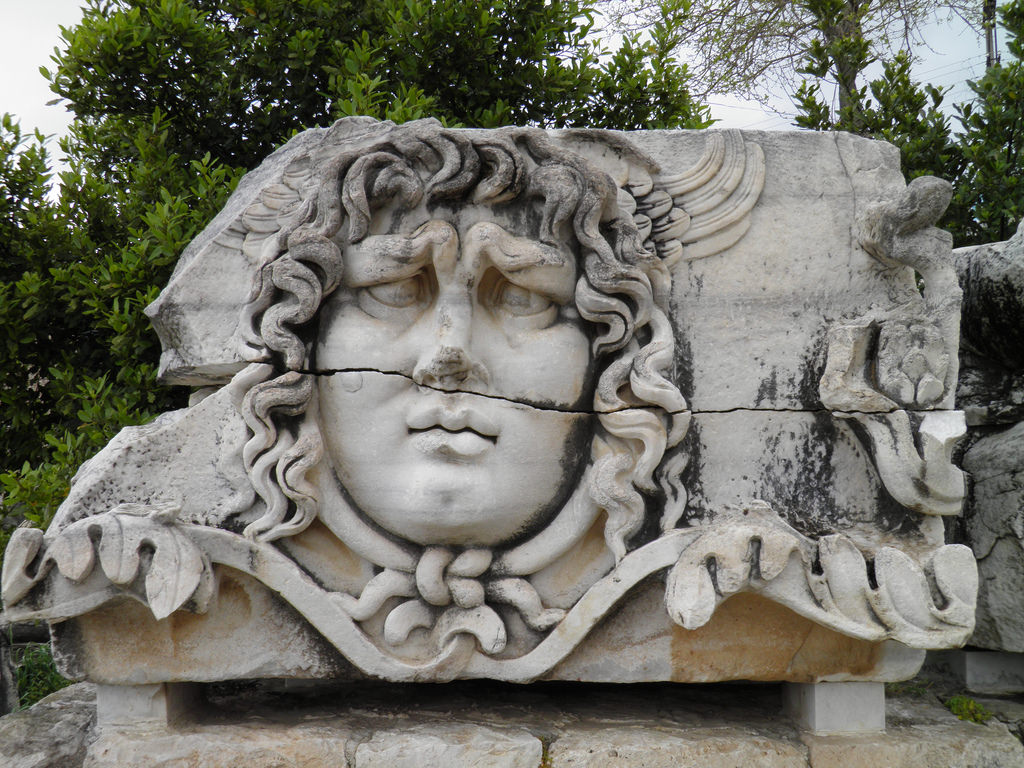
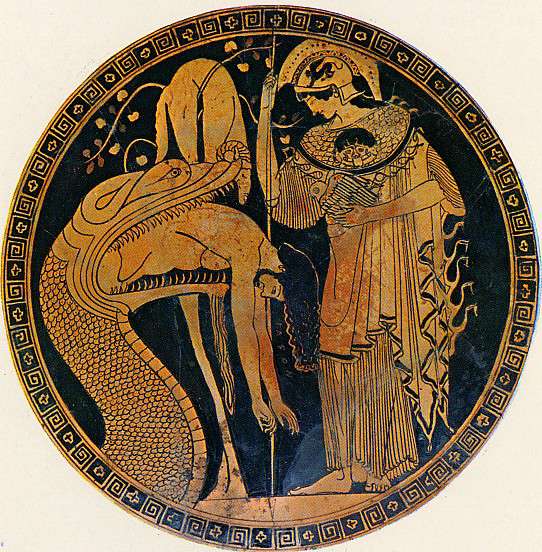
If one wanted to ward off evil in ancient Greece, one would decorate clothes, buildings, or jewelry with the face of a gorgon to stop evil in its tracks just like Medusa could drop you dead like a rock with just one glance. The gorgon’s face was not pleasant. It had fangs, wild eyes, a protruding tongue, and unruly hair. Now that I think about it, this also describes me before I have had some coffee in the morning.

A gorgon’s face was a standard ornament for armor but also used in architecture, clothing, rugs, and jewelry. According to standard mythology, the Greek goddess Athena put on her dad’s favorite jacket, the Aegis, and then decorated it with a gorgon’s face as a fitting example to humans about the proper way to turn away evil while dressing well.

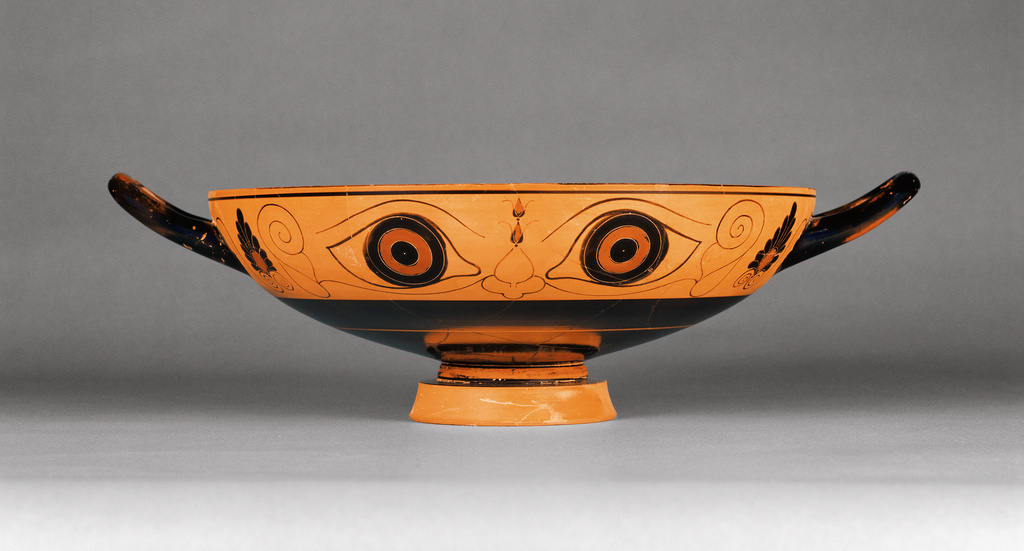
Likely related to the scary gorgon’s face was the representation of eyes, either as a set or singleton, to intimidate evil. Drawing a single eye was much easier than illustrating a gorgon. For the art impaired, drawing an eye was a cheap, fast, easy means to ward off malevolent glares. In ancient Greece there were eyes on cups (lest one swallow evil) and ships (shipwrecks were a big problem). If you visit modern Greece or much of the eastern Mediterranean, you will see a similar symbol adorning everything from buses and homes to fine jewelry. The iconic Mati or blue eye often appears in a lovely Aegean blue glass (much nicer than the fanged googly-eyed original). These make a lovely way to give evil the boot.

The Romans chased off evil or envious glances with jokes and funny pictures. Both the Greeks and Romans used images or charms of (ehem) a certain body part to scare away evil. These charms – often used for earrings, lamps, or necklaces—were called fascinum/fascina. The term “fascinating” comes from the name of these (ehem) charms. The term was meant to imply that one had been put under a spell. The term may or may not have anything to do with the fasces, the bundle of rods and an ax carried by lictors before the Roman consul. Fasces, not fascina, led to the modern term “fascism.”

Meanwhile, back to scary faces: gargoyles were ugly enough to scare evil away from important buildings in Europe. The English term “hunky punk” described grotesque scary carved architectural bits, but I think it might fit for some members of boy bands.


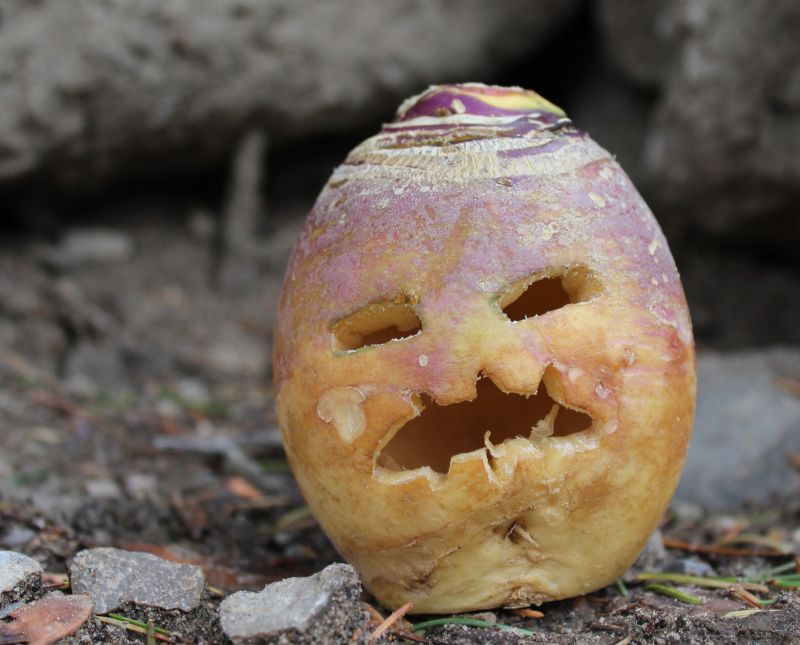
If one wanted an affordable home-spun ugly carved-thing, turnips did the trick for many years. Thankfully, turnips are as difficult to carve as they are to eat so other fruits or vegetables cycled through the list of options. Celts adopted winter cucurbits (squash, melons, etc) as an easier way to scare away evil since they were available right after harvest when people celebrated the new year.

The idea of apotropaic fall fruits resonated well in the early colonies of the United States where settlers needed some extra good luck. North American tribes gave us the names for squash (a Massachusett word, askꝏtasquash or a Narragansett word, askútasquash) and pumpkin (Massachusett pôhpukun meaning “grows forth round”). 

Growers are happy to offer every type of pumpkin, squash, and gourd for the purpose carving and stacking while (thankfully) turnips fell out of style. These carve-worthy fruits make tasty pies for Thanksgiving plus delicious roasted the seeds!


September 27, 2021

Failure is a Valuable Learning Tool

Toddle –To walk with short, unsteady steps

By Amy Barr with The Lukeion Project 

    All three of my clever competent children have successfully made it to adulthood in one piece. When they were toddlers, I was not so sure they would cross that finish line. When children learn to walk and then go careening into their new world to explore, their development is nothing short of death-defying. There will be endless head-bonks. Gravity will be challenged. Cats, houseplants, fragile items, and parental patience will be fully tested. Learning to toddle out into the world requires trial and error. Success is almost certain unless a toddler is kept too safe. Trial and error are necessary.

Fast forward to a person’s school years when new challenges line up. Failures are not measured by toppled chairs or head bonks (at least not too often), but challenges remain necessary for those who want success.

Children who will learn to cook must be able to chop food (with a knife!) and use a stove. Those who take up a new instrument will experience plenty of sour notes. Everyone who wants to learn dance or to excel in gymnastics, will endure more than a few sore ankles and stubbed toes. Want to learn to ride a bike, use roller skates, master a skateboard, or play football? Get ready for bonks, bruises, and broken bits. It is normal. It is required! Nobody expects to be the top gymnast, execute a 180 heelflip, or score a winning touchdown before loads of challenging work and a stack of failures.

We humans expect consistent setbacks when learning new physical skills, but do not offer ourselves the same grace when mastering new academic skills.

As we progress through our education, we decide about our skillsets too quickly. We learn to self-identify as math or science kids, “bookworms,” “creatives,” or “jocks” even though we must all master math, physical activities, literature, writing or expression. We must all get in touch with our own creativity plus a bit of biology and botany.

Few of us become a polymath, one whose knowledge spans a substantial number of subjects and draw on complex bodies of knowledge. Why? We interpret academic bonks and bruises differently; we think they are proof that we will never be good at something academic.

“Ugh! I get mediocre grades in algebra, I’m just not a math person.”

“Yuck, I never do well on written projects. These are too difficult.”

“My creative project wasn’t half as good as everyone else’s. I guess I’m not creative.”

What if we let our academic bonks and bruises serve us the same way they do when learning physical skills? Do you regularly miss deadlines? Let that bonk teach you new ways to manage time. Do you often miss details on tested subjects? Produce new mastery technics that suit your brain best. Do you lose interest and focus during reading assignments? That bruise is not there to get you to stop reading but tell you it is time to find coping mechanisms that help you retain focus throughout a whole assignment.

Finally, do not fall for the poor advice that you are perfect just the way you are, no more effort needed. You and I both know that you would prefer to feel confident about things that interest you and you would rather feel at least competent in things that interest you less. Humans are happiest when we are toddling forward, learning new things, and acquiring new skills. Bruises and bonks let us know when to strengthen ourselves in some way so we can become proficient, then competent, and then finally confident. Failure is a valuable learning tool.

Deadlines First Hurt Then Help

By Amy Barr with The Lukeion Project , in charge of lots of things and especially Latin 1-7 The start of a new academic year at last! We...