September 7, 2020

Above All, Don’t Quash the Squash

Sundry Garden Metaphors for Educating your Own

By Amy E. Barr, Latin guru at The Lukeion Project

Pardon all the garden talk lately. It is that time of year. I moved to the middle of nowhere so I could have a big garden, chickens, fruit trees, and fewer neighbors. Before I took up the responsibilities of owning a bit of land, I fancied myself as clever about growing things. I was wrong. My horticultural efforts are only impressive to the most amateur neophytes and those that see my carefully edited photographs on Insta. Painful comparison of my efforts to successful growers comes weekly when I visit the nearby Amish community. Their lovely produce is a nice supplement to my inability to grow enough potatoes and cucumbers in any given year. I confess I did manage to produce some fine cabbages and squash this year for once. I’ve been growing things and gardening since I was a kid, but I still have a lot to learn.

If I were to give up my day job teaching Latin, it would be fun to teach gardening lessons. My first bits of advice would be: prune often, coddle seldom, and thin regularly. Since my day job is teaching young people, my advice can be a bit similar so hang in there, we are about to talk veggies.

Prune Often

Tomatoes, roses, peach trees, and most people, do best with regular pruning. When it comes to people, think of pruning in terms of well-calculated challenges. Twelve long years of bland or overly simplified education results in adults who seldom bloom. If a tomato just sprawls on the ground, it will continue to leaf, but it will not produce much fruit. Challenging a plant with a good pruning along with a bit of support and feeding, followed by several more pruning sessions is a good tactic in education. Support and nourish? Yes. Challenge and rectify? Also, a big yes. Growth, blooms, and fruit are stimulated when students encounter challenging subjects, endure a set back or two, and then learn to grow past failures and challenges while they meet new ones.

I once met a gifted student who was terrified by the thought of even the smallest academic failure. His terror was so severe that he had to be cajoled into completing every single assignment given to him. Hoping to mitigate his academic anxiety, his mother made it far worse by constantly trying to “help” him avoid those very academic challenges. She begged for extensions, she pled for special grading, she demanded a unique schedule, even though this student performed quite well whenever he decided to do so. This student had been fed and supported, but never pruned much.      

Coddle Seldom

This year I grew a bed of giant sunflowers. I love their cheerful yellow but admire their ambitions to grow to 10 or 12 feet before sustaining the weight of massive seed-filled blooms. Winds, thunderstorms, squirrels, and a few chomps from our old goat Otis (living next door) did not knock them down. They went from sprouts to towering giants in a few months. They grew strong because they were not shielded from sun, wind, and rain. They were given appropriate challenges along maturation so that I never had to prop them up artificially.

Students can grow the same way. Education shouldn’t be something done TO or FOR a child, with minimal expectations of the child’s engagement in his or her own education…yet it often is.  There’s no magic grade level in which a student can start working on challenging or exciting subjects after clocking enough hours in boring worksheets, primers, and prerequisites…yet we often think there is.  Likewise, too powerful a challenge at too young an age can stunt grown.

Learners are like young plants. The wind must blow, and the rain must fall from the start so that a student responds appropriately and grows strong enough to sustain harder challenges. Greenhouse veggies are tender, but they need hardening-off before you can plop them in the garden. Don’t keep your learner in the greenhouse for twelve years. Let them enjoy some sun and rain now.    

I once spoke with a person who bought an exotic specimen tree for her front yard. Since the tree was still small but represented a sizable investment for her landscape, she strapped a strong pole to the little trunk to make sure it grew straight and tall. After the tree had grown for two years, she decided it was mature enough to remove the support pole. She was horrified to find her little tree snapped in half after a rainstorm a week later. Strapped to external support, the coddled tree had not encountered any real challenges as it grew. It appeared to have been maturing, but appearances were deceptive.

Thin Regularly

Carrots are difficult vegetables. They don’t like to germinate and, when they do, they take their sweet time about it. Carrot experts always plant way more seeds than necessary if they plan to get a normal harvest. If one is patient enough to grow carrots, one is also aware of the need to thin those hard-won sprouts before they crowd each other and fail to grow. Thinning carrots is a tedious, but necessary task for everyone planning on a good harvest. What can carrots tell us about education?

Thin your child’s schedule regularly so he or she won’t get crowded out. Thin intelligently and in the best interest of your learner rather in the best interest of somebody else. Lots of upper level high school students forgo classes that interest them so they can pile on prestigious classes that might look good on a transcript. Sure, an ambitious student should add an AP class or two, but only if the subject is engaging to the student. I teach an AP Latin class. About three-quarters of my students love the subject. It gives them great satisfaction to succeed at that level of Latin so the AP credit is a nice bonus. About one-quarter of my AP students are there because they hope it will look good on a transcript. They are not terribly excited about the material, but they will spend a lot of energy on it anyway. They are likely taking a variety of other AP classes and they are stressed to the max. Instead of easing into their best transitional year, they are tired and a little bitter. Crowded schedules keep people from healthy growth, regardless of their age. Thin the timetable a bit if you want to see improved development.  

Don’t quash the squash

This time of the year my garden is consumed by a few sprawling winter squash plants. As the main growing season comes to an end, I don’t mind if my pumpkin vines start to crawl over the asparagus or shoot up the tomato trellis. There’s an especially sturdy offshoot headed into my cowpea patch right now. I try to keep the roots watered, fed, and relatively bug-free while vines head in all directions. If a vine is relatively healthy, I let it head off on its own unchecked. In a few weeks, I’ll look for the fruit (hopefully some butternut squash, some pumpkins, and maybe a large summer squash that went unnoticed too long under the vines). Some of the biggest and best fruit comes from healthy vines that were allowed to grow in a direction of their own choosing.


August 29, 2020

Good Literature Informs Life

Literature has the power to shape character and steer paths long after the last page is turned.

whale

By Dr. Susan M. Fisher, Classical Lit. Guru at The Lukeion Project

Call me Ishmael. Rather, call me Ahab, because that’s who I am in this particular tale. The setting: my vegetable garden. The “white whale”: an unseen deer that keeps getting into my beds and topping my plants.

This analogy came to me the other morning when I was yet again shoring up the defenses of my netted gardens against what has been an unprecedented onslaught of deer damage this summer.

This story, however, is more about the fact that I compared my struggle to that of Captain Ahab against the relentless Moby Dick than it is about the struggle itself, especially since Moby Dick stands out as the one book I really and truly loathed from my high school literature classes.

What struck me as funny is the fact that despite my feelings about this book, it was informing my life, as good literature does. Was I becoming obsessed by the deer as Ahab was with the whale? Was I ignoring other important aspects of life and work in my pursuit of victory? Would Ahab’s mostly pyrrhic victory be my fate as well? I pondered these thoughts and more while I staked and netted, pulled weeds and picked beans.

The importance of literature has taken many blows in the last decade or more as colleges have gotten more expensive and students now compete for jobs in a global arena. As humanities departments have shrunk, the value of literature has been obscured in the myth that it does not have direct relevance to the post-academic world. Nothing could be farther from the truth.

Certainly not everyone will become an English teacher, but that is not the point. Nor is literature just a fun past-time, although it is that as well.

Beyond being a good read, high-quality literature informs life. It has the power to shape character and steer paths long after the last page is turned.

Jobs come and go. In fact, according to the 2019 Bureau of Labor Statistics people change jobs, on average, twelve times in their lives. But people live with themselves their entire lives. The lessons of literature read will be there to inform, challenge, condone, console, and influence them the whole time.

As I continued to work in the garden my thoughts moved from the censure of the Ahab revelation to thoughts of permanence. The impending shift to the fall garden had me thinking that, unlike the Latin poet Horace, I was not “building a monument more lasting than bronze” nor would my vegetables nor I escape Libitina. This might have made me sad if I had not remembered the words of Japanese author Motoori Norinaga that “To know the beauty of the passing of things is to discern the power and essence, not just of the moon and the cherry blossoms, but of every single thing existing in this world…”

While I worked, I was Mary Lennox in The Secret Garden, wondering awestruck at some small seedlings unfurling. I was Laura Ingalls Wilder preparing for the impending Dakota winter. I was my grandmother and hers before her and generations yet to come. I was continuing Wendell Berry’s legacy of place and community and innovating like William Kamkwamba who harnessed the wind. I was all of these and more.

Humans are natural storytellers and good literature cultivates this predilection. In fact, so powerful is the force of a well-written story that not only can it resonate with us whether we liked it or not, but it will continue to steer and shape us long after we put it down. This is quite an investment.

March 9, 2020

Advanced Placement Classes – Are They Worth It?

By Amy Barr, The Lukeion Project

I teach AP Latin. I teach 15 to 20 students for each two-semester course. Most of them will also complete the AP Latin exam, set locally each May. In a normal year, 75% of my students do very well (score of 4 or 5). 15% will earn a low pass and will still likely earn college credit for that score. One, or very rarely two of my students will earn less than a score of 3 on the exam.
Every year these academically ambitious students ask each other the same question: How many AP classes are you taking now and how many do you plan to take before you graduate? Invariably, a couple of them will put the rest into existential crisis mode by claiming they plan to take at least 4 or 5--every year for three or four years of high school. 
How many exams should students take? How will they ever get into college with “only” one or two AP classes?! Are there drawbacks to too many? ..To too few? ..To none? Let’s list the pros and cons of taking AP classes before we get to that answer.

Cons of Taking AP classes

Risk of doing poorly

Taking an AP course is just preparation for completing the AP exam scheduled each May. The biggest risk in taking an AP class is that one does poorly and inadvertently proves one is not prepared for college-level work. This will be a hit to the GPA and plus your college admissions officer will be unimpressed with your academic readiness. A related problem would be failing to follow through after an AP course to take the AP exam. Colleges/universities place little extra value on AP classes without a subsequent success on the exam, even accounting for weighted grades. An AP class is a college-level course. Failing to take the exam, failing the exam, or failing the course proves you aren’t ready for college. When in doubt, leave it out. Do not provide proof to the admissions board that you aren’t yet ready for college. Avoid rushing into a class that seems over your head.

Risk you won't get college credit

I witness social pressure on students to take as many AP classes as possible though the motives are often financial rather than academic. This is understandable. A passing score on an AP exam can be more reliable than scholarship hopes. AP scores can convert into college credits while saving a load of money. A good score in AP Latin, for example, is the equivalent of first-year (grammar) and second-year (translation) Latin at the college level.
Colleges are not obligated to take your passing AP scores and convert them to credits on your transcript. Your college program may not offer the equivalent course for which you completed an AP exam so even a perfect AP score in macroeconomics will be received with zero fanfare by a program in, say, engineering or sports science.
Some colleges only wave prerequisite courses based on AP success with no net gain in credits earned. Others will only award credits to students who earn the highest possible AP score (5).
These facts aren’t unreasonable considering universities would prefer student dollars be spent with them while using their faculty and their own degree standards.

Risk that you'll feel out of sync

Perhaps all goes well, and a student earns the maximum number of AP credits possible for their desired institution (which will be limited - check with the college). There remains one last issue which is true for all students who test out or take dual credit: Such students may stay permanently out-of-sync with their college peers.
To facilitate student retention, many schools schedule a week of freshman events designed to build student confidence and, most importantly, forge essential social connections. Those who “test out” of their freshman (or even sophomore year) through AP, CLEP or dual enrollment will often attend freshman orientation but this won't solve the issue. Alas, such students may never attend a single class with these peers. It can be a lonely business to start college with a slew of 300-level classes filled with very busy advanced college students who have little time to forge new friendships with first-year students.

Risk of burn out

AP students who over-do can skid to an exhausted halt at high school graduation. Some will have been working toward college at such a fevered pitch that they’ve neglected important relationships and failed to master essential life skills better taught by a part-time job and volunteer work. Now they are close to burn out when they’ve only just begun.

Pros of taking AP classes

Wow! The cons seem bleak! Advanced Placement classes have plenty of benefits, too.

Proof of abilities

They can set college applicants apart and demonstrate their ability to perform well in college-level coursework, even better than jumping into early classes at the local community college. Success on one or more AP exam proves that a student can manage time and can handle the tough stuff.

Opportunity for challenge

Advanced placement classes can offer much needed academic challenge in a sea of otherwise dull course offerings for students who need more challenge. Eager to sharpen your teeth on more interesting material? You are well suited to sprinkle a few AP classes throughout your high school career regardless of the added benefits of credits and honors. Gifted kids are often craving the challenge. AP classes are ready to go.

Finish the basics faster

Advanced placement classes can offer students the chance to test out of basic subjects that will apply to their program. Lukeion students who finish AP Latin, for example, will be perfectly comfortable in a 300-level Latin class even while they finish other program requirements like Greek, or as they add a nice double major.


How many AP classes are a good idea?

Balance is the key to everything. If you have your eyes set on the most competitive academic program, the admissions committee would prefer to see applicants with a variety of experiences rather than too strong a focus on purely academic metrics. AP classes should be just one of many features on the larger map of things that makes a student desirable for college admittance. The best songs have many notes.
Students: instead of frantically taking 4 AP classes every semester, try taking 1 or, at the most, 2. Focus your energy. Do beautiful work in a reduced AP class load. Excellence in fewer AP courses will pay higher dividends and may help you secure excellent references from your AP teacher. Leave time for activities that demonstrate leadership, creativity, openness to new experiences, and initiative. This should include travel abroad, volunteer hours, a part-time job, participation in community theater or symphony, sports, or any dozen other ways that will make life worth living NOW while they make you a more interesting candidate in the future.
If you crave challenges, take as many as you please. The courses themselves will your reward.
The sweet spot for a typical student who just wants to prove she has a solid academic preparation is lower than most expect. Four or five AP classes/exams (TOTAL) will be enough, even for students set on top schools. One or two will do if you aren’t shooting for an Ivy League. Want to skip the AP rat race entirely? Many non-AP students shine on the merits of a high school education made richer by elements of travel, work, volunteerism, and pre-college experiences in intended majors or minors. Colleges are increasingly preferring this type of student over one-note applications with AP-packed transcripts.
AP classes are not a golden ticket. They are not even a prerequisite for college entry any more than they are a guarantee of college success. They are, however, a good metric of college readiness. So, do them if you like, and do them well…just don’t overdo them.

March 2, 2020

Learn to Communicate Well from the Start

By Amy Barr, The Lukeion Project
As online educators who can’t see students' faces or raised hands, the instructors at The Lukeion Project strongly encourage students to develop good communication skills as early as possible. The importance of learning how to express oneself accurately and persuasively is not limited to student/instructor emails. Students must start with the basic skills needed to ask for a little Latin help and develop them into the full-color palette of abilities needed for longer academic projects in upper-level classes. Students must start early as they learn how to communicate effectively. 
Communication today is all about precision and concision on one hand, and persuasive detailed expression on the other. Whether you are writing an email to your instructor, asking your coach for advice, developing a persuasive argument to win a good grade, or just texting your mom to ask for a few more hours at a friend’s house, good communication is a learned skill that takes time and attention to develop. If you are a student, here are a few suggestions for developing yourself in this area.

Students (not parents) should email their instructors

Sure, educators can seem scary, plus mom (or dad) are already old pros at sending emails. What’s wrong with getting your parents to fire off a fast request to the instructor? Learning how to ask questions artfully, requesting extensions persuasively, imploring a second look at a score politely, or asking for clarifications humbly, all build the basic building blocks of good communication. The failure to either provide enough precise information or to politely self-advocate may end in undesirable results. There's excellent motivation for learning how to write your instructor with skill.
Being precise, concise, and persuasive are qualities that never magically pop up on their own. They don’t just suddenly blossom when you hit a certain age. The only way you can grow comfortable with effective communication is to start with small tasks then build to bigger ones. Trial, error, and experience are key.

Students should embrace writing challenges instead of avoiding them

Ask a college professor. He or she will tell you there are two kinds of students: those who can write, and those who can’t. College professors hope you know how to write a good research paper when you walk into their classrooms. Students who come to college with these skills well in hand will find they are 75% less stressed than their classmates who arrived in class without a clue. Unequipped students will need to camp out at the writing lab in all their spare time. Well-prepared students get to focus their energies on their actual classes.
Several of our semester classes require research papers because such assignments develop critical thinking, project management, time management, plus clear, persuasive, organized, and analytical writing. Students should build their skills with emails early on but then be quite conscientious about continuing to building them (Skillful Scribbler and Muse Series) so that a student is ready to take the classes that require persuasive writing (Rhetoric) as well as research papers (Classical History or mythology)--by 10th grade or--at the very latest--11th grade. After students have been through a couple research papers, they are ready for classes like College Composition, College Research Writing, as well as our AP classes that require subject mastery plus excellent analytical writing.

Students should learn to express their ideas fully

Many of the exams that you will take at The Lukeion Project will require assigned essays. Students lose points by failing to express their answers to the prompt fully. There is no virtue in a short or vague answer. A single rambling paragraph wins few points.
Educators assign essay prompts to see if a student fully understands elements of the course such as an assigned reading passage, an epic plot, a historical event, or any of dozens of things that should be synthesized from things they read and heard. Those who answer an essay prompt vaguely or with few specific details have failed to grasp the basic expectation of an essay.
Always write as detailed and as complete a response that your exam time will allow you to write. Don’t quit early. Demonstrate your mastery and comprehension fully. Impress your readers.


February 24, 2020

Why Put Yourself to the Test with the NGE or NLE?


It is the Classical Language Exam Time of the Year!

by Amy Barr, The Lukeion Project
This week’s blog is going to be a bit more specific to TheLukeion Project as we discuss the National Greek Exam (March 2, 2020) and The National Latin Exam (March 9, 2020). I’ll answer the most frequently asked questions about why we participate in these exams and offer some last-minute encouragement as you prepare for these competitions.


Why does The Lukeion Project participate in the NGE and NLE each year?

There are a zillion different approaches, curricula, and programs that promise students a chance to study Latin and Classical Greek. Sadly, some of these approaches offer no more than vague language familiarity, even after several years of “hard work.” Others—especially The Lukeion Project—make language mastery the goal. How can we make this claim without some standardized exam results to back us up? More importantly, how can you –the student—claim to have attained excellence without some standardized test results to back you up? Participating in the NLE/NGE is a great opportunity to compare your efforts to other students worldwide.
“The National Greek Examination in 2019 enrolled 1774 students from 173 high schools, colleges, and universities in the US and around the world.” There are seven levels: Introduction to Greek, Beginning Attic, Intermediate Attic, Homeric Odyssey, Homeric Iliad, Prose, and Tragedy. The exam is offered by the American Classical League.
Roughly 140,000 students take the NLE. “The National LatinExam (NLE) is a test given annually to Latin students across the United States and around the world. The NLE is not meant to be a competition but rather an opportunity for students to receive reinforcement and recognition for their accomplishments in the classroom. Depending upon their score, students may earn certificates, medals, and may even qualify for scholarships.” The exam is sponsored by the American Classical League and the National Junior Classical League and is offered to students on seven levels.
Neither the NGE nor the NLE exams are based on any specific textbook series so students will be put to the test in a fair comparison across the board. Roughly half of the students who participate worldwide will earn honors at varying levels. On average, 95% of Lukeion Latin students and 90% of Lukeion Greek students earn honors each year. For the NLE, Lukeion students typically earn in the ballpark of 3% of all perfect papers scored each year worldwide.


Shouldn’t I “wait until I’m better” at the languages before taking the test for the first time?

Both the NGE and NLE exams come in 7 forms and are meant to be taken annually for every level completed by the student. Students gain valuable experience by taking exams yearly and they might also be awarded special book awards (and even a shot at scholarships) if they earn gold medals for three successive years. Around a dozen Lukeion advanced students (NLE III – NLE VI) will be awarded prestigious book awards for three (or more) years of success annually. While scholarships are very limited, students are only offered the chance to apply for them after completing the NLE III level. So, take the exam that corresponds to your level from the start (we do not offer the Intro level for our students)


Do I get credit in my language class? If not, why bother to study?

Much satisfaction can be realized when one prepares well for a challenge and when one is recognized for the attainment of mastery of that challenge. This fact has been true about human beings for as long as we have records regarding the fastest, smartest, and bravest. There’s a tremendous feeling of success shared by those who compete and do well in sports, debate, performance, cooking, painting, or…Greek and Latin! Working hard is its own reward but getting a bit of extra recognition for that hard work – at the international level – is a nice boost to one’s confidence.


Taking any exam makes me nervous so why voluntarily take something like the NLE or NGE?

Many of us are naturally exam adverse. Reasons can include test-anxiety, fears of failure, or maybe a little laziness, truth be told. Academic tests are inevitable unless you plan to quit your formal education quite young. The only thing that makes all those inevitable quizzes, tests, and exams more endurable is practice and experience. The NLE and NGE offer the added benefit of (a) not causing any permanent damage to your transcript if things go badly, and (b) the potential of much laud and honor if things go well. In other words, do your best but there's nothing to lose.
So, why voluntarily put yourself through extra study effort over the next few days leading up to your NGE and NLE dates? For now, you’ll improve your language mastery, which will benefit your course grade. In the future, you’ll demonstrate your language mastery, which will strengthen your future transcripts. In the long run, you’ll attain language mastery, which will strengthen every part of your thinking, writing, and speaking henceforth!   

February 17, 2020

History is a Labyrinth (not a Line)

Time Meanders More than You Know

By Amy Barr, The Lukeion Project

History timelines can be fine teaching tools. They provide a crisp visual to help us understand where goalposts stand as we look backward. Goalposts can help us see cause and effect, such as when the printing press lead to a surge in literacy; automobiles enticed people from cramped cities into suburbia; soap extended lifespans and freshened the air. But history really isn’t simple, and it is never a straight path. Connecting dots to make a few straight-line history lessons tends to leave out lots of dots!
Relationships between world events are less like timelines and more like ripples in a pond or crisscrossed spider webs. To appreciate history, you must meander a labyrinth, not walk a line. 
Specific dates of even major historical events are seldom known with certainty as we travel further back in time. Humans have recently all gotten together to rely on a neat 12-month calendar and a new year each January 1st. They mostly do so now only because our computers and airports require this common time language. Some nations enjoy more than one date-keeping system to accommodate technology and tradition at the same time.
Before computers helped standardize date keeping across the globe, humans recorded events by calculating the time since the last Olympiad, the years since the start of a king’s rule, the decades since the last eclipse, or the centuries since a city was founded. Serious historians don’t just flip to a single commonly accepted timeline when they want to talk about when things happened. A good bit more math and mystery must be solved to build goalposts on the ancient timeline.
How can one mark a permanent “X” on the timeline of history? Consider the founding of Rome. Textbooks tell us Remus lost the bid to name the city to his twin, Romulus, in 753 BC. The actual date of this fraternal squabble was debated for centuries by the Romans themselves. Over 700 years after the event some Romans favored the theory it all took place on April 21st soon before an eclipse calculated 438 years after the fall of Troy (Velleius Paterculus, 8). An equally compelling theory put Rome’s founding in 747 BC, dating it to the 8th Olympiad.
After the monarchy, the Romans themselves mostly kept track of time by the name of the two consuls in charge each year. Romans started counting years after Rome was founded using the AUC system (ab urbe condita). In AD 525 Dionysius Exiguus attempted to calculate the year of Christ’s birth and started numbering the years of history from that point starting with AD 1 (anno domini).  All years prior to that date were later termed in English “BC” for “Before Christ.” This way of numbering years did not catch on broadly until after AD 800. Historical scholars working with all primary texts for events prior to AD 800 need to be chronologically savvy about the various dating systems in play.
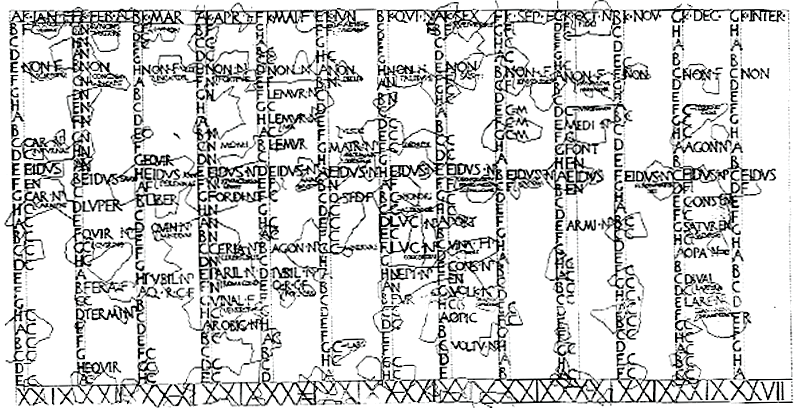
Knowing what year it was could be problematic for an ancient person. Knowing what day it was could be impossible. Trial and error taught people some systems were more reliable than others. The moon was an easy calendar guide since it was visible everywhere, and lunar cycles divided the year into months of 29 or 30 days. Lunar months don’t add up to 365 ¼ days a year. Every few decades the days and months drifted out of season. Harvest holidays would show up in icy winter and spring holidays were celebrated in sweaty summer. In Rome, politicians were asked to toss in an extra month to even things out. It was hard to write to a friend in Thrace or Egypt to meet in Athens or Rome on a definite day. Everyone kept track of dates a bit differently. Appointments always allowed for plenty of flexibility.
On February 24 in AD 1582, a large part of the planet got on-board with the solar calendar system we use today. All Catholic countries of Europe agreed to keep time the same way when an edict was issued by Pope Gregory XIII. His reason for strictly regulating the calendar was so all Christians could celebrate Easter on the same day. This idea was first suggested by the church fathers at the Council of Nicaea in AD 325 but the idea got stuck in committee for a very (very) long time. 
This Gregorian calendar of AD 1582 fixed flaws in the older system set up in 45 BC by Roman statesman Julius Caesar. That wily old politician won the powerful office Pontifex Maximus early in his career. Among other perks, his job as Pontifex required him to declare an intercalary month between February and March as needed whenever the months of the year started to get off track. Ever the consummate politician, he took the best advantage of the situation. He was allowed to make some years longer to extend the political terms of allies, or make them shorter is an adversary was in office.
With a hectic schedule of conquering Gaul, fighting Pompey, and touring Egypt meant the Roman calendar was neglected by Caesar too long. He finally found a moment to fix time in 46 BC. In addition to the traditional spare month between February and March, he added another 67 days between November and December. That year seemed to go on endlessly, but Caesar’s new Julian calendar was a hit. It followed the solar year closely and the Romans enjoyed the luxury of knowing when summer started, when to make plans for Saturnalia, and when to plant a garden. 
“March,” “April,” “May,” “June,” plus “September” (7), “October” (8), “November” (9) and “December” (10) were named by Romulus in his original 10-month calendar.  The next king added January and February to the start of the year. Months named “seven” through “ten” became months nine through twelve evermore. The Roman month Quintilis would be later be renamed “July” but only after Julius was slain. The month Sextilis became “August” to honor Caesar’s heir, the first Roman emperor Augustus.  Other emperors tried to rename months but failed (thankfully). Emperor Commodus, for example, energetically named all the months after himself. The Romans quickly flushed those names down the drain once he died.
Relationships between people, places and events can make history a wonderful web of cause and effect. Like ripples in a pond during a rainstorm, events combine and overlap with surprising results. Each nation has used different ways to mark time. As you study history this year, make marking time part of the puzzle to be solved.       

February 7, 2020

3 High School Skills for College Success

By Amy Barr

As your high school years zoom by, you’ll find yourself increasingly preoccupied with things like where to go to college, scores on excruciatingly long standardized tests, GPA points, transcripts, and how to handle college tuition costs. Stay the course! There’s going to be some nice satisfaction when you (or if you are the parent, your child) gets that college acceptance letter. All the inner critics can hush up. Well done! but are you ready to succeed once those first college classes start?

The next level will bring a fresh set of challenges. Peculiar cafeteria food and roommate troubles are as predictable as too little campus parking and overpriced textbooks. Some college troubles are easy to anticipate. Others will be unpleasant surprises unless you prepare now during his high school years. Getting to college is actually the easy part. Staying there is the real challenge. To help, I’ve come up with three common-sense skills you must develop during your high school years. Work on these now. Enjoy smooth(er) sailing later.

1. Develop Excellent Research Writing Skills and Practice them Frequently in High School

Creative writing tends to take center stage because let’s face it, research writing can sound intimidating to all involved so it is easier to do (and to assign) the creative projects. At college, research writing is the must-have skill that professors will assign but will not likely teach.
With a phone in every pocket and a computer or tablet in every backpack, data is now incredibly easy to find. College educators have shifted to focus on one’s ability to analyze and synthesize copious amounts of data. Whether you want a degree in law, business, biology, engineering, or even Classics, you must know how to find reliable sources, research well, and then write precisely, analytically and persuasively. Don’t start college unless you have practiced research writing several times or there will be struggles ahead.

In classical education, the rhetoric stage includes high school and college years. This is when the human mind is well suited to the development of research writing skills. Students are ready to research facts and complex ideas then express logical answers to important questions as they persuade others with clear analytical writing.  In practical terms, start writing research papers early in high school so that this skill has time to become college-ready.

Homeschool Parents: If you have misgivings about how to teach this subject to your student, enlist the aid of others who teach or write research pieces professionally. Find friends with degrees in research fields and sweet-talk them into objectively grading your young writer’s efforts. Encourage your teen’s co-op teachers to assign research papers in high school classes. Be willing to master research writing for yourself while you both develop writing skills.
 

2. Train for “adulting skills” while still in high school

The skills needed to boost college success are often simple “adulting skills” that should be sharpened well before dorm move-in day. Common-sense abilities like money management, self-control, and determination will help throughout college, career, marriage, and life. Knowing how to change a tire and cook a decent meal are icing on the cake!

An essential college skill is time-management. Many students who fail at college did so because they weren’t able to balance social activities and part-time jobs with their need to study, sleep, do some laundry, grab some decent food, and get to class. To avoid time management disasters, learn to juggle your own schedule now while you can still cheaply handle a few disasters. At college, mangled schedules will cost time, money, and tuition. Find a planning system and learn how to use it now instead of after a disaster happens.

Homeschool Parents: If you are still doing all the scheduling, organizing, and teaching during your teen’s high school years, your first step is to hand much of the job off to your teen. Have him take over his own academic and life schedule. Let him work out his own academic planning. Walk him through the process of evaluating his course load and learn how to allot the time needed for each subject. Have him plan for trips, work, music lessons, sports, and free time. Making mid-course adjustments to a hectic schedule is part of the learning package, no extra charge.

3. Practice healthy failure recovery

Parents: As a master of one’s own schedule, the student must suffer the consequences for poor planning, even if it means she earns a low score on a quiz or paper. The resolve of many well-meaning parents melts when the student’s transcript pays the price of priorities gone awry. If procrastination is your teen’s struggle it is better to earn a poor grade now than fail in college. Understanding his own limitations means he’s on his way to better time management. He is also on his way to developing the third most practical college skill: failure recovery.

Learning how to recover from a failed task is vital. Mastering this piece of the puzzle will make all the difference. College will be an untidy mix of positive and negative experiences that ultimately teach us a lot about ourselves. If your teen is crushed by even minor setbacks now, you’ll need to practice healthy recovery every chance you get before freshman orientation.
High school is a time of countless mental changes. The process will feel like three steps forward, two steps back. Use these four years wisely to help your student mature in these three areas. May too few parking spaces, weird roommates, and questionable cafeteria food be the worst disasters she’ll suffer in her college years.

January 31, 2020

How an Italian Volcano Changed America

Amy Barr, January 31, 2020, in part originally a June 2012 article for The Old Schoolhouse

Villa San Marco (and the Lukeion Educational Tour group)
Several years ago, I visited our nation’s capital. My kids were still young at the time so standing in line was great for teachable moments lest boredom became an issue. While waiting to see The National Archives an impromptu group of listeners formed as my husband and I, both Classical Archaeologists, explained the neoclassical images ornamenting the building. An eavesdropper remarked, “I didn’t know this art had to do with Greece and Rome!” Almost every artistic element on the building intentionally refers to our two Classical civilizations.

Thomas Jefferson was more than the architect of our Declaration of Independence; he was also fascinated by real architecture as he imagined the construction of our new nation. He gave considerable thought to crafting buildings to last for generations. Jefferson could have recommended the flowery architecture of European cathedrals or the onion-bulb towers of Russia or even down-to-earth austere Colonial style. Instead, he dreamed up enough columns and capitals to make Caesar himself feel at home.

Certainly, our nation’s founders drew inspiration from the Classical world but particularly Roman ideas were brought to the fore in the late 1700s because two factors came to play at that moment in time. First was Jefferson’s brilliant Classical education in both Latin and Greek. Second, was the unearthing of thousands of mysterious things in northern Italy that had remained hidden since the tragic eruption of Mt. Vesuvius in A.D. 79. Essentially, the rediscovery of all things Rome came to light during our nation’s most formative years.

Pliny (the younger) tells us that one warm August day his uncle Pliny (the elder) noticed a strange cloud in the distance near what is today Napoli, Italy. He observed that this cloud was shaped just like a pine tree. If you haven’t been to Italy, you may not know that there, pine trees are shaped like umbrellas. Pliny was grasping for words to describe this event since such a catastrophe had never been witnessed before.  Romans would eventually learn to call this natural disaster a volcano.

Natural curiosity and steadfast Roman bravery would win out over terror on the day of the eruption.  Pliny the elder rushed to help the panicked residents of the area as darkness closed in around him and his military craft. Pliny the younger, however, did not go. His uncle had assigned him a writing project so that 17-year-old decided to finish his schoolwork instead of sailing headlong into an exploding mountain. His uncle would not survive the adventure. He himself would provide one of our only eye witness accounts. 

The eruption would last for three excruciating days. When it was over, what had once been lush vineyards, pleasant hillsides, and thriving towns—most notably Pompeii and Herculaneum—would look lifeless and ashen like the surface of the moon. The dead remained where they fell, utterly forgotten for seventeen centuries.

In 1738 excavations began in Herculaneum, well before archaeology included any science. Workers knew nothing about the events that placed these items in the ground. Mystery added to the beauty of the discoveries. Soon Europe was engrossed with the ruins of Herculaneum and Pompeii, her sister city, discovered in 1749. As workers uncovered perfectly preserved homes, temples, baths, sculptures and paintings, a remarkable thing happened: the world’s imagination was captured by ancient Rome and, by association, ancient Greece. What had once been forgotten now retook center stage in the minds of the best thinkers and doers of that day.

When Thomas Jefferson was ambassador to France from 1784 to 1789, he took a few well-earned breaks. He scoured France looking at her Romanesque architecture, he toured her Roman ruins, and he voraciously read Classical authors (both Latin and Greek) looking for insight, inspiration, and warning.  Having started his Classical education at age 9, he was fluent in Greek, Latin and at least three other languages, skills that would inform every aspect of his career. He too felt the powerful pull of Pompeii and the potent words of Roman authors. Thomas Jefferson and John Adams would work together to craft a constitution with a tripartite system of government which found its roots in Rome. Jefferson himself would introduce the neoclassical style of architecture to the United States.

All this enthusiasm was not just because he thought Roman buildings were majestic, but because he believed that the Roman Republic’s system of checks and balances was a brilliant idea for our new nation. What better model for our architecture?  Ever the student of Roman history, he also knew that a nation must be vigilant lest it topples at the hands of a tyrant as Rome once did.

Intellectual souvenirs from his time in France included his design of the Virginia State Capitol, the University of Virginia, and Monticello, his home. He would suggest the name “Capitol” after the Capitoline hill in Rome and would inspire the plan for our Capitol building modeled on the ancient Pantheon of Rome. So, when you look at it this way, from the ruins of Rome and the ashes of Pompeii would come the enduring structures of our nation. At least in some small way, the tragic end of the cities of Vesuvius would inspire the rise of America.

January 24, 2020

Succeed at Failure

You Really Can't Succeed Without Some Failure

By Amy E. Barr with The Lukeion Project
An earlier version of this article appeared in The Old Schoolhouse in 2012

As every new school year starts, I will find out interesting tidbits about my students… like how this student is gifted or that student is challenged. All students are expected to complete the same assignments and quizzes on schedule. Here’s the interesting part: many of my gifted students do a superb job until they have a bad week. One or two low quiz scores later and some of my cleverest kids will give up. Meanwhile, my average and challenged students keep going, calmly taking setbacks in stride.

There’s no mystery here. Gifted students tend to be self-critical but as perfectionists even while difficult subjects come easily to them. They rarely meet a mental mountain they can’t climb, so failure is rare. When it does happen, the sting is especially painful. Average and challenged students are more accustomed to academic struggle. A little failure (or at least not highest success) may be on the menu daily for these learners. In turn, they respond more casually to disappointments. Experience tells them that failure isn’t fatal, and life goes on. Consequently, many parents of gifted kids are constantly looking for challenging subjects, not just to avoid boredom but also to maintain a healthy response to adversities.

Enter the study of Classical Latin or Greek: Even if a student has been brought up by a pair of Classics professors, he is not going to be spontaneously brilliant in these challenging topics—just ask my adult kids. Learning Latin or Greek is always a matter of hard work. Success and failure will come to all. Only hard work will mark the difference. This can be earth-shattering to the perfectionist who misinterprets the struggle to learn a tough subject as being “bad” at that subject. It can alternatively become a great opportunity to learn how to succeed at a little failure.

Do you grant lots of do-overs, re-tries, and mulligans? Does your child get second, third, and fourth chances on every academic challenge? Do you set deadlines for academic projects and then move those goals back two or three times? From time to time, all of us unintentionally prevent our children from mastering healthy recovery from failure by shielding them from failures. With the best intentions, we may try to nurture our children so carefully that they don’t suffer a real academic setback prior to college. By then, the first low grade or poor paper may be emotionally crushing and financially costly.

Extra chances, no firm deadlines, and daily do-overs may seem like a great way to teach a subject well—but be careful. Deliberately shielding a student from failure will do measurable damage. Students who should otherwise be flourishing will instead fail to develop confidence, self-esteem, or resilience. Such qualities are the result of a healthy response to, and recovery from, adversity.
Motivational teacher Paul J. Meyer summarized our need for a balance of success and failure with these words: “By seeing the seed of failure in every success, we remain humble. By seeing the seed of success in every failure we remain hopeful.” What can you do to improve healthy failure recovery in your student’s world?

First, if you are your child’s primary educator, check your own teaching habits. If your child learns in a more conventional schooling environment, examine expectations.  Can your student constantly retake quizzes, re-do assignments, and push back deadlines? Firm up expectations and stick to stated consequences.

Second, raise the bar. Increase challenges, set expectations high, and then model healthy recovery when inevitable failures arise. Playing a musical instrument or reading a foreign language (such as Latin and Greek) is terrific at providing challenges, failure recovery, and pride over hard-won success when it comes.

Finally, praise your child for being determined instead of smart. Enthusiastically celebrate the hard work involved in a difficult task. A person’s determination is always a better determination of success compared to natural talent. Everything will come with more practice and more hard work. Success is 80% determination and 20% smarts. All of the latter can be compensated for if one has enough determination.

No matter how smart you are, you’ll experience trial and error, failure and success, good days and bad days. Learning that failure isn’t fatal is the first step toward lifelong success. Provide challenges for yourself (or your learner) so you have the opportunity for a bit of failure every day. Experience failure and then, most importantly, respond to that failure realistically and with determination to push on into growth.

January 16, 2020

Some Secrets to Academic Success You Should Know

By Amy E. Barr of The Lukeion Project

Three Important Skills to Succeed in Any Class

1.  Read the syllabus

College classes have a syllabus, a document spelling out course expectations, rules, laws, and (hopefully) a schedule of all assignments. At The Lukeion Project, we provide a syllabus for all semester classes, even for our youngest students. A syllabus is an excellent communication tool if students will read it.
Instructors prepare the syllabus with the exactness of a legal document, which it is. A good syllabus spells out everything you should know about a class. Read it with care because we educators are going to stand our ground on what has been communicated in a syllabus. If we state all deadlines are firm, expect firm deadlines. If we specify how things must be turned in, a wise student follows that directive with care or loses points.
The syllabus works to the advantage of both educator and student. If we neglect to include an important detail on the schedule, we are likely to be sympathetic if you miss the item due to an incorrect syllabus.
Educators will fine-tune a syllabus until it includes everything that is important to know about a class. If a syllabus is a single page or 12 pages long, read it. It is obvious when a student has failed to read the syllabus by the mistakes that are made or the types of questions that are asked. When a student doesn’t read the syllabus, the educator might make some unflattering assumptions. Meanwhile, the student leaves a horrible first impression. Read the whole syllabus carefully.

2.  Always Come to Class and be on Time

Aside from the inevitable illness or minor calamity, make every effort to come to every class. As your education becomes more and more expensive (with respect to both personal time and money), increase your zeal for always attending class. To do any less leads your educators to assume you are lazy, disinterested, disorganized, or disengaged. Who wants to be in these categories? When one needs his educator to offer a bit of grace, one’s chances improve greatly if one has been careful with timely attendance. Most importantly, as you progress in your education, you will have already paid for and reserved that dedicated class time. Use it to focus on the material and learn instead of sleeping through it. It won't be easier to focus on that material later while on your own. At all costs, come to class and be on time.

3.  Ask Thoughtful Questions

Is there such thing as a dumb question? We covered the need to avoid questions already answered in the syllabus. Paradoxically, almost all other questions are a good idea in class with the important exceptions that I have listed below. Are you a big question-asker in class? Is that a good thing? Educators nearly always appreciate question askers (unless they are running low on time). Students need not worry they will be considered dumb if they ask questions about the material covered in class. Question-askers are fully engaged in the topic and focused on mastery of the subject. What’s not to like?  There are, however, a few important question-caveats.

Don’t Ask…

  • Any non-topical question that is likely answered elsewhere. Read your syllabus or go through a class handout first. Your educator wants to save limited class time (and limited personal time to answer emails) so help her out by not asking due dates and class policies that are stated elsewhere.  
  • “Will this be on the quiz?” Class time is precious. Educators rarely waste lecture time on things that don’t matter. Don’t waste even more time by asking that question! Assume everything will be on the quiz and you’ll never miss a thing.
  • “Did I miss anything?” (When late or if you miss a class). This question communicates a belief that class time has been meaningless without you! Rather than evoke an annoyed comment from your lecturer with this question, assume you missed many important things and then ask a peer for missed notes AFTER class.
  • “When will X, Y, Z be graded?” First, this isn't truly your question. You are actually telling your educator to put aside everything to focus on YOUR grades. Nobody is more eager to finish grading an assignment than your educator. He or she has already skipped meals and sleep to finish grading and preparing for your class. Consequently, this question always comes off as irritating at best, insulting at worst. That’s not how you want your educator to think of you.

Do:

  • Stay on-topic. Avoid asking about the weather in Spain when the session is about Latin nouns.
  • Rephrase a question or further engage the instructor for a better understanding of the subject. Educators love to engage students fully in the topic at hand.  
  • Ask for help if you are confused. It is better to ask for clarification than to miss points. If you’ve done your job by reading the syllabus, textbook, class notes, and a peer, it is time to ask your instructor for help. Sometimes that missing assignment link or confusing page assignment needs to be fixed for everyone anyway. 

Be a Scaffold

  Help Helpfully By Amy Barr with The Lukeion Project We love our kids. Parents want their children to develop strong life skills, int...